Building an Audience Before You Launch (Without a Big Following)
7 min read
The short answer
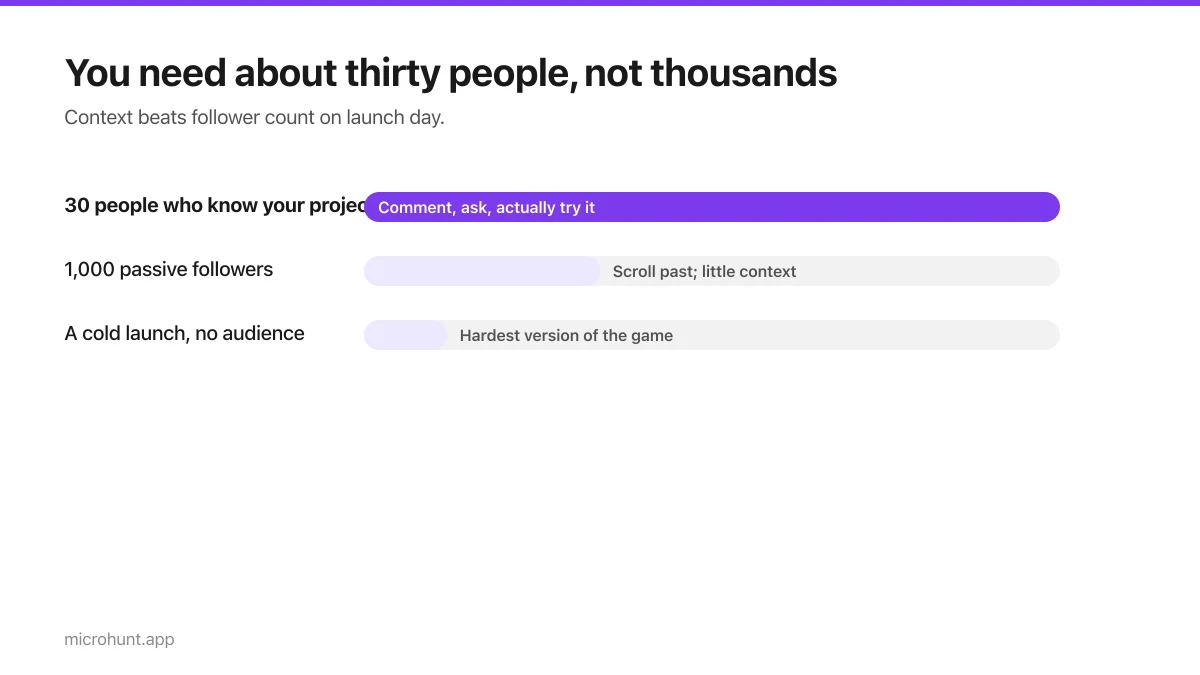
You need about thirty people who know what you are building, not thousands of followers. Get them by being genuinely useful in one or two communities where your users already are, for a few weeks, without pitching. Then show your work as you build so the launch is an update rather than an interruption.
"Build an audience first" is advice that sounds like it requires a year and a newsletter. For a launch, it does not. The threshold is far lower than people assume — roughly thirty people who recognise your project when they see it.
Why thirty is enough
Thirty people who genuinely know what you have been building will produce more meaningful launch activity than a thousand passive followers. They comment, which pulls in strangers. They ask real questions, which makes the thread worth reading. And a handful of them will actually use the thing and tell you why they stopped, which is the outcome that matters.
Pick one or two places, not seven
The most common failure is spreading thin — a bit of X, a bit of LinkedIn, a subreddit, a Discord, all shallow. Depth in one community beats presence in five.
| If you are building | Try | Because |
|---|---|---|
| Developer tools | A relevant subreddit, GitHub discussions, Hacker News | Technical audiences reward demonstrated craft |
| Design tools | Design communities, X, Discord servers | Visual work spreads through visual channels |
| B2B software | The one newsletter your buyer reads, LinkedIn | Buyers are reachable in professional contexts |
| Consumer apps | Niche subreddits, short video | Launch boards skew toward makers, not consumers |
| Hardware | Maker communities, specialist forums | Questions get specific and knowledgeable fast |
Be useful before you are interesting
The first few weeks should contain no promotion at all. Answer questions in your area. Help people debug things. Share something you learned that cost you a day. This is not a strategy for tricking people into liking you — it is how you find out whether the problem you are solving is one people actually have.
Then show the work
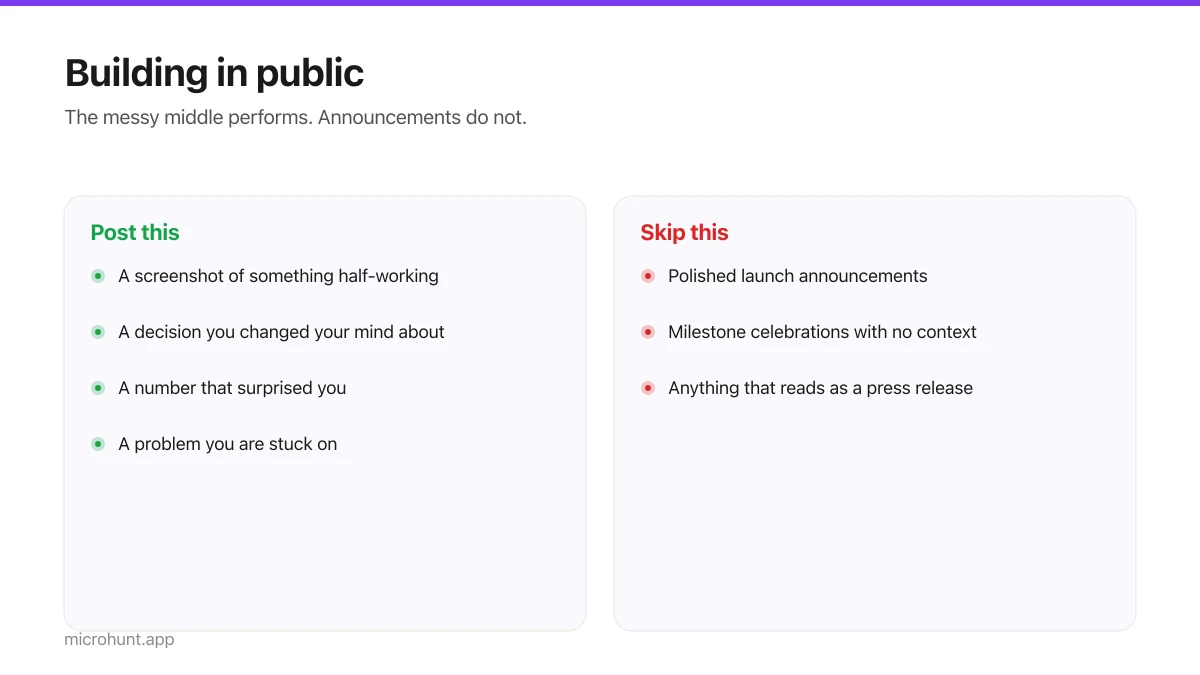
Building in public works because it gives people a reason to be interested before there is anything to sell. The posts that do well are not announcements — they are the messy middle.
- A screenshot of something half-working, with what is wrong with it.
- A decision you changed your mind about, and why.
- A number that surprised you.
- A problem you are stuck on — people genuinely like helping.
- Something you tried that did not work.
What performs badly: polished announcements, milestone celebrations nobody has context for, and anything that reads as a press release.
The week before
- 1Say the dateOnce, as information. "Going live on the 14th" — not a request for anything.
- 2Ask two people to look earlyPeople who have followed along. Ask what is confusing, not whether they like it.
- 3Fix what confused themThis is the last cheap opportunity to fix your copy before it meets strangers.
- 4On the day, post once per placeIn your normal voice, in the same communities. Then stay and answer everything.
That is the whole method. It takes about a month of low-effort presence and it changes launches more than anything else available to a maker without a budget. The day-of mechanics are in the seven-day launch checklist.
Frequently asked questions
- How big an audience do I need to launch?
- Around thirty people who know what you are building is enough to make a launch feel alive. Passive follower count matters far less than the number of people with genuine context on your project.
- How long before launch should I start?
- Three to four weeks of being present in one or two communities is enough for a first launch. Longer helps, but the returns flatten quickly compared to the effort.
- Does building in public actually work?
- It works when the posts are honest about the messy parts. Announcements and milestone posts perform poorly; half-finished screenshots, changed decisions and problems you are stuck on perform well because they give people something to respond to.
- What if I have no audience at all and want to launch now?
- You can, and plenty do. Expect a quieter day, and treat it as a way to collect feedback rather than users. Then do the community work and relaunch properly when something meaningful has changed.
Keep reading
How to Get Your First Upvotes Without Begging
What actually generates early votes, why vote-for-vote groups do not work, and the approach that keeps paying off after launch day.
The Seven-Day Launch Checklist
A day-by-day plan for the week before you launch, weighted towards the things that actually change the outcome.
Free Launch Platforms for Indie Makers (No Budget Needed)
You do not need to pay to launch. Here are the places that are genuinely free, what each expects from you, and where paying is actually worth it.