Free Launch Platforms for Indie Makers (No Budget Needed)
7 min read
The short answer
Every major launch platform is free to post on, including Product Hunt, Hacker News, Reddit, Indie Hackers and Vuru. Paid options mostly buy you placement or a faster review queue, not a better result — a weak tagline stays weak in a featured slot. Spend the money on your first screenshot instead, or on nothing at all.
A lot of launch advice quietly assumes a budget. Hire a designer for the hero image, buy a newsletter slot, pay for a featured listing. Most of the makers who submit to our board have none of that, and it matters much less than the advice implies.
Here is what is genuinely free, what each place expects in return, and the two situations where paying is actually the right call.
What free actually gets you
| Platform | Free to post | What it costs you instead | Catch |
|---|---|---|---|
| Product Hunt | Yes | A day of your attention, and prep time | Crowded days; finishing outside the top few is quiet |
| Hacker News | Yes | A thick skin | Show HN has strict conventions; read them first |
| Yes | Weeks of participating before you post | Self-promotion rules differ per subreddit and are enforced | |
| Indie Hackers | Yes | A story worth reading | Works far better with real numbers attached |
| Vuru | Yes | Ten minutes filling the form in properly | None — submit here |
| Niche newsletters | Sometimes | A genuine relationship with the writer | Sponsored slots are paid; editorial mentions are not |
The free things that actually move the needle
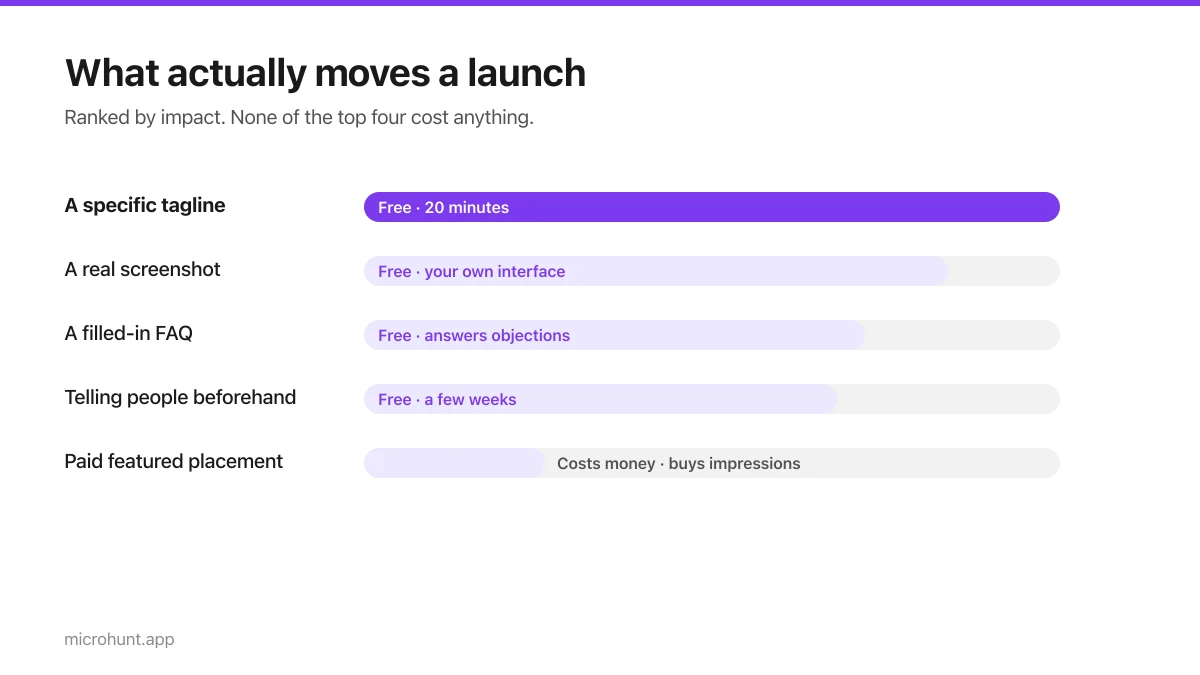
When we look at which submissions on our board get clicked and which get scrolled past, the differences are almost never budget-related.
- **A specific tagline.** The single highest-leverage free thing you can do. We covered the mechanics in how to write a product tagline.
- **A real screenshot.** Your actual interface with real content in it, not a stylised render. Free, and it beats a paid illustration almost every time.
- **A filled-in FAQ.** Answering the awkward questions — pricing, data handling, what is missing — converts better than another paragraph of positioning.
- **Telling people beforehand.** Not asking for votes. Just saying, for two or three weeks, what you are building and why.
- **Replying to everyone.** On launch day, answering every comment properly is worth more than any promotion you could buy.
When paying is actually worth it
We are not against spending money. There are two cases where it makes sense, and a lot of cases where it does not.
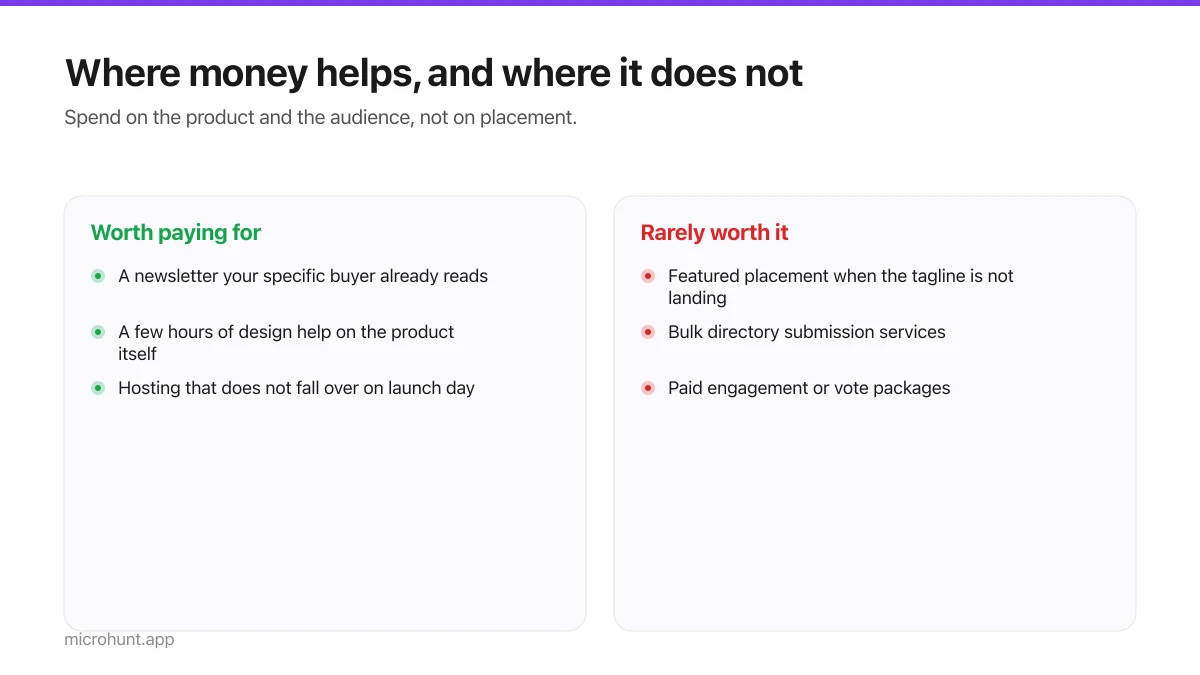
Worth it: a newsletter your buyer already reads
If your product serves a specific job — dental practices, Rust developers, wedding photographers — there is probably one newsletter those people actually read. A sponsored slot there can outperform a top-three finish on a general board, because every reader is a plausible customer.
Worth it: design help for one asset
If your product is visual and your screenshots look rough, paying someone for a few hours to tidy the interface itself is money well spent. Note the distinction: improve the product's appearance, not the marketing image of it.
Usually not worth it: featured placement
Paid placement on a launch board moves you up a page. It does not make people want the thing. If the tagline is not working, a featured slot buys you more impressions of a message that is not landing.
A free launch plan that works
- 1Weeks one to three: be useful somewherePick one or two communities where your users already are. Answer questions. Do not mention your product unless it genuinely answers someone's problem.
- 2Week four: write the pageTagline, description, features, FAQ, screenshots. Show it to two people who do not know the product and fix whatever confused them.
- 3Launch week: stagger itSmaller board first, then a community, then the biggest platform. Each one improves the copy for the next.
- 4After: keep the pages aliveListings get indexed and keep working. Update them when the product changes rather than leaving a stale page from launch day.
None of that costs anything except time, and it outperforms most paid launches we see. If you want the day-by-day version, the seven-day launch checklist is the practical companion to this post.
Frequently asked questions
- Is Product Hunt free to launch on?
- Yes. Submitting and launching is free. Product Hunt sells promotional products around launches, but you do not need any of them to post, and paid promotion will not rescue a tagline that isn't landing.
- Is Vuru free?
- Yes, entirely. You can submit a product, upload a logo and screenshots, add features and FAQs, and attach a deal without paying anything. There is no review queue to skip.
- Do paid launch services work?
- They buy attention, not interest. If your positioning is clear and your product is ready, paid placement can add reach. If the tagline is vague, it multiplies the number of people who scroll past. Fix the copy first, then consider spending.
- What is the cheapest way to get first users?
- Being genuinely useful in a community where your users already spend time, for a few weeks before you launch. It costs only time, and it consistently outperforms every paid channel available to a small maker.
Keep reading
Best Product Hunt Alternatives for Launching in 2026
Where else to launch when Product Hunt is not the right fit — what each platform is actually good at, who shows up, and what it costs.
The Seven-Day Launch Checklist
A day-by-day plan for the week before you launch, weighted towards the things that actually change the outcome.
How to Write a Product Tagline That Actually Gets Clicked
The one line most people will ever read about your product, and a simple test for whether yours is doing any work.