Best Product Hunt Alternatives for Launching in 2026
Updated 31 August 20268 min read
The short answer
The best Product Hunt alternative depends on who you need in the room, not on which site is biggest. Developer tools do better on Hacker News and dev-focused boards, consumer apps do better on Reddit and TikTok, and niche B2B tools often do better in one good newsletter than on any launch board. Most makers get more from launching in three smaller places over a month than from one big day.
We get a version of the same email most weeks: someone has built something, they are ready to show it, and they are trying to work out whether Product Hunt is worth the effort — or whether there is somewhere better. It is a fair question, and the honest answer is more boring than most listicles admit.
There is no single best alternative. There are places where your specific audience already spends time, and places where they do not. A CLI tool and a meditation app have almost nothing in common as launches, and treating them the same is the most common mistake we see.
Why makers look for an alternative in the first place
From the submissions we see, the reasons cluster into four groups, and they point at different solutions.
- **The day is crowded.** Big launch days are winner-take-most. If forty products go up and you finish eleventh, the traffic difference between eleventh and thirtieth is close to nothing.
- **The audience is wrong.** A board full of AI tools is a poor room for a hardware product or a service aimed at accountants, no matter how good the product is.
- **They have no existing audience.** Launch boards reward people who arrive with an audience. Turning up cold is the hardest version of the game.
- **They want the link, not the spike.** Some makers are chasing a durable, indexable page more than a day of traffic. That is a different goal and it changes where you should post.
The main options, and who each one suits
We have deliberately not put traffic numbers in this table. Published figures for these platforms are inconsistent, they change constantly, and the number that matters is how many of the right people see you — not the total.
| Where | Who is there | Best for | Cost |
|---|---|---|---|
| Product Hunt | Makers, investors, early adopters, a lot of other founders | Broad consumer and B2B software with a visual product | Free to launch; paid promotion exists |
| Hacker News | Engineers, technical founders | Developer tools, infrastructure, anything open source | Free |
| Everyone, sorted into very specific communities | Consumer apps, games, niche hobby tools | Free, but rules vary wildly per subreddit | |
| Indie Hackers | Solo founders and small teams | Bootstrapped products, revenue stories | Free |
| Smaller launch boards | Mixed; usually maker-heavy | A durable listing page and a backlink | Free tiers common; paid skips the queue |
| Niche newsletters | One tightly defined audience | B2B tools where the buyer is specific | Often paid, sometimes the best value |
| Vuru | Independent makers, people browsing by category | Small tools that benefit from a categorised, permanent page | Free — submit a product |
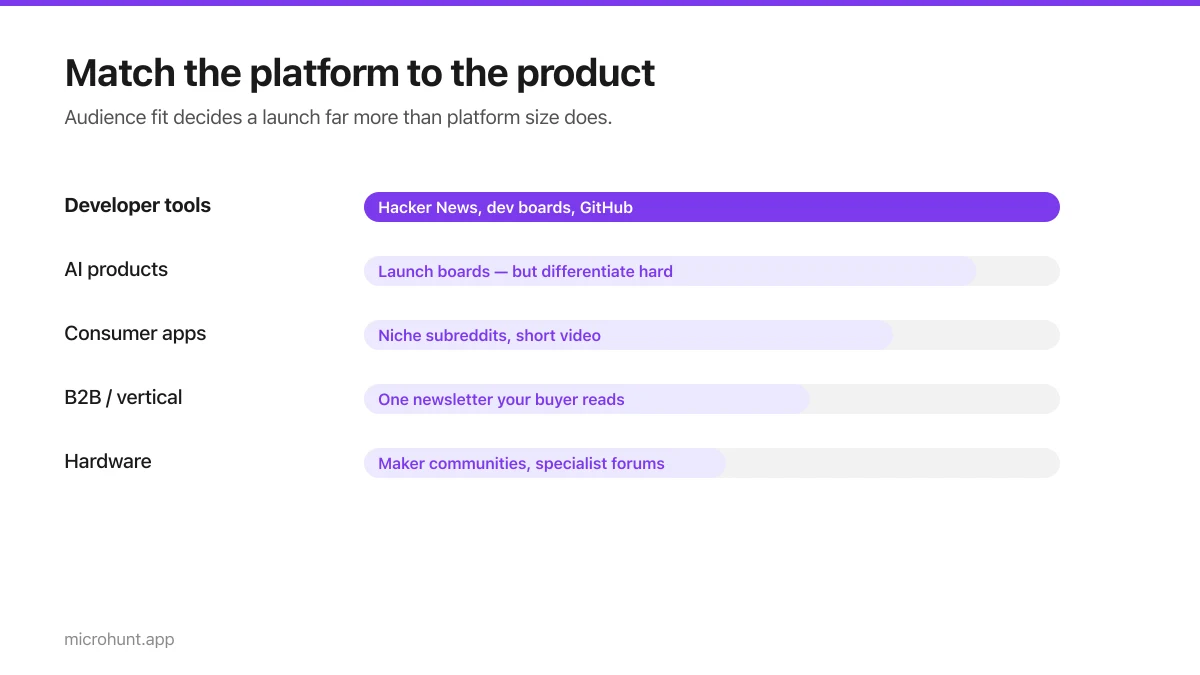
Match the platform to the product
This is the part most guides skip. Here is how we would think about it by product type, based on what actually performs on our own board and what makers report back from elsewhere.
Developer tools
Engineers are sceptical of marketing language and generous with genuine craft. Show the command, show the output, link the source. Hacker News rewards this heavily, and so does our Developer Tools category. A polished landing page with no code in sight will underperform a plain README with a good demo.
AI products
This is the most crowded space on every board, which means differentiation carries the whole launch. Saying what your model does that a general assistant cannot is worth more than any amount of design polish. We wrote more on this in launching an AI product.
Consumer apps
Launch boards skew toward people who build software, not people who use consumer apps casually. A recipe app or a habit tracker will usually find more real users in one well-chosen subreddit or a short video than on any maker-focused board.
Hardware
Hardware is rare enough on launch boards that it stands out, which works in your favour. The catch is that questions get specific fast — shipping, certification, repairability. Have those answers on the page. Our Hardware category goes into what that audience checks.
Launching in more than one place
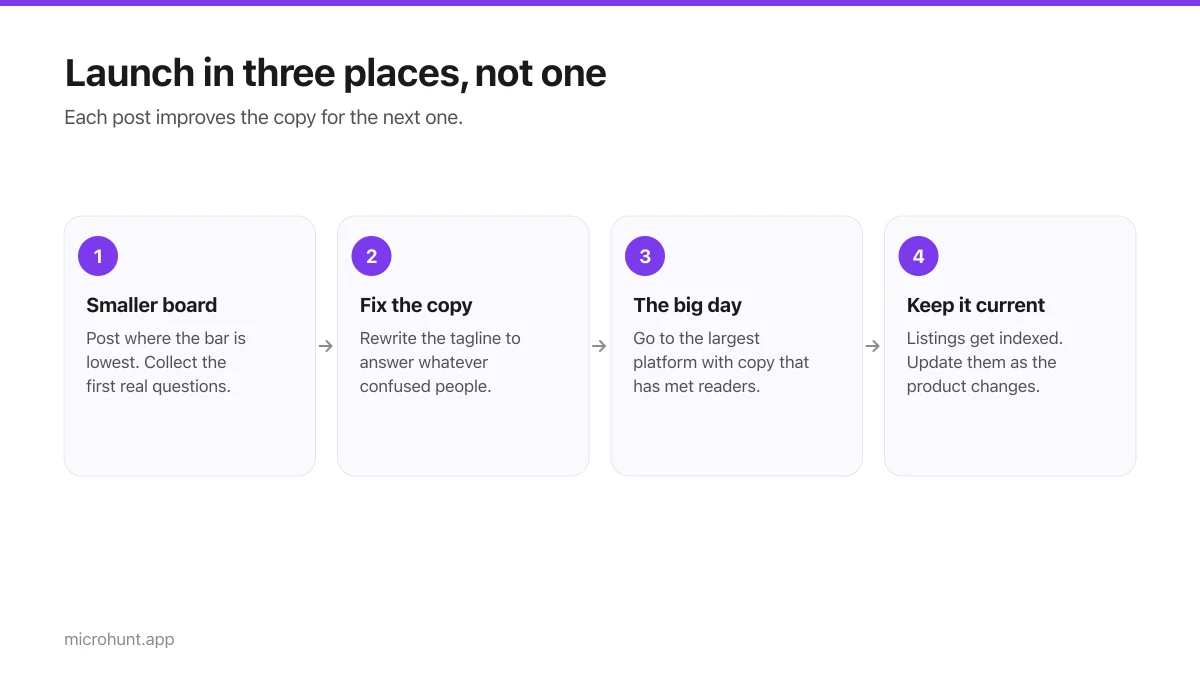
The pattern we see work most reliably is not a single big day. It is a staggered month.
- 1Start where the bar is lowestPost to a smaller board or a relevant community first. You will get your first real questions here, and they will improve your copy before the bigger day.
- 2Fix what confused peopleEvery launch surfaces the same two or three misunderstandings. Rewrite the tagline and the first paragraph to answer them.
- 3Then do the big oneGo to the largest platform with copy that has already been tested on real readers, not on your own assumptions.
- 4Keep the permanent pages currentBoard listings get indexed and keep sending trickles of traffic for years. Update them when the product changes.
What a launch is actually worth
Set expectations honestly before you spend two weeks preparing. For most independent products, a good day on a major board produces a traffic spike lasting two to three days, a modest number of signups, a permanent indexed page, and — most valuably — a small number of people who will answer your questions afterwards.
That last group is the real prize, and almost nobody optimises for it. If you finish your launch with six people who tried the thing and will reply to an email, you have more than most first-page finishers get.
If you want the practical version of all this, our seven-day launch checklist covers the preparation, and what to do after launch day covers the part that matters more.
Frequently asked questions
- What is the best Product Hunt alternative?
- There isn't one best alternative — it depends on your audience. Hacker News suits developer tools, Reddit suits consumer apps, niche newsletters suit specific B2B buyers, and smaller boards like Vuru suit makers who want a permanent categorised listing. Most people do best launching in two or three places over a month.
- Can I launch the same product on several platforms?
- Yes, and you should. There is no exclusivity requirement on any major launch platform. Stagger them across a few weeks rather than posting everywhere on the same day, and rewrite the copy for each audience rather than pasting the same blurb.
- Are launch platforms free?
- The major ones are free to launch on, including Product Hunt, Hacker News, Reddit and Vuru. Some smaller boards charge to skip a review queue or to feature a listing. Paid placement rarely fixes a weak tagline, so spend on the copy first.
- Do I need an audience before launching?
- It helps enormously, but you can launch without one. The makers who do best without an existing audience are the ones who spent a few weeks beforehand being genuinely useful in the communities where their users already are, rather than arriving cold on launch day.
- How long should I spend preparing a launch?
- About a week is usually right for a first launch. Most of that time goes on the tagline, the first screenshot and the FAQ — not on the assets people assume matter. Beyond a week you are usually procrastinating rather than preparing.
Keep reading
Free Launch Platforms for Indie Makers (No Budget Needed)
You do not need to pay to launch. Here are the places that are genuinely free, what each expects from you, and where paying is actually worth it.
Where to Launch a SaaS Product in 2026
A practical ranking of launch channels for B2B software, and why the smallest one often produces the most customers.
The Seven-Day Launch Checklist
A day-by-day plan for the week before you launch, weighted towards the things that actually change the outcome.