What to Do the Week After Launch Day
7 min read
The short answer
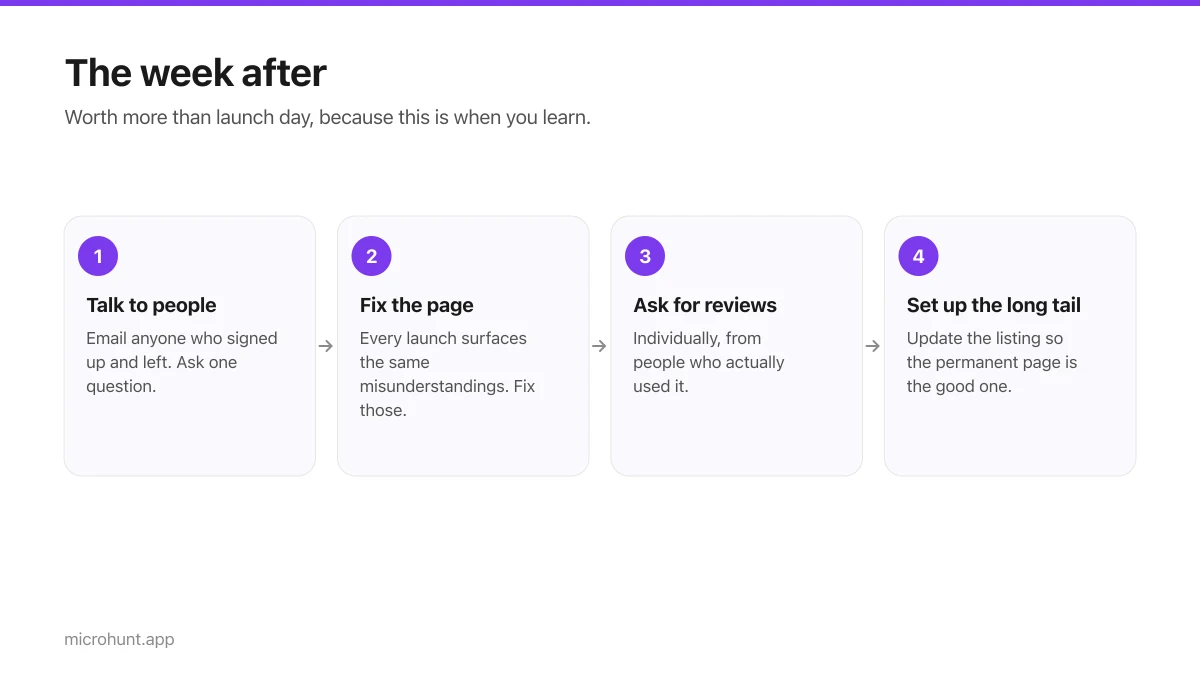
The week after launch is worth more than launch day, because that is when you find out what people actually thought. Email everyone who engaged, collect the questions you were asked repeatedly, update your page to answer them, and ask a handful of real users for reviews. Treat the launch as the start of a conversation rather than the end of a project.
Launch day ends with a graph that goes up and then down. Most makers look at the down part and conclude the launch failed. What actually happened is that the spike ended, which was always going to happen, and the useful part started.
Day one after: talk to people
The single highest-value thing available to you is a conversation with someone who tried the product and did not stick with it. They know something you do not, and for about a week they will still remember why.
- Reply to every comment you did not get to on the day, even the late ones.
- Email anyone who signed up and did not come back, asking one question — what stopped you?
- Thank the people who wrote something substantive, by name.
Days two and three: fix the page
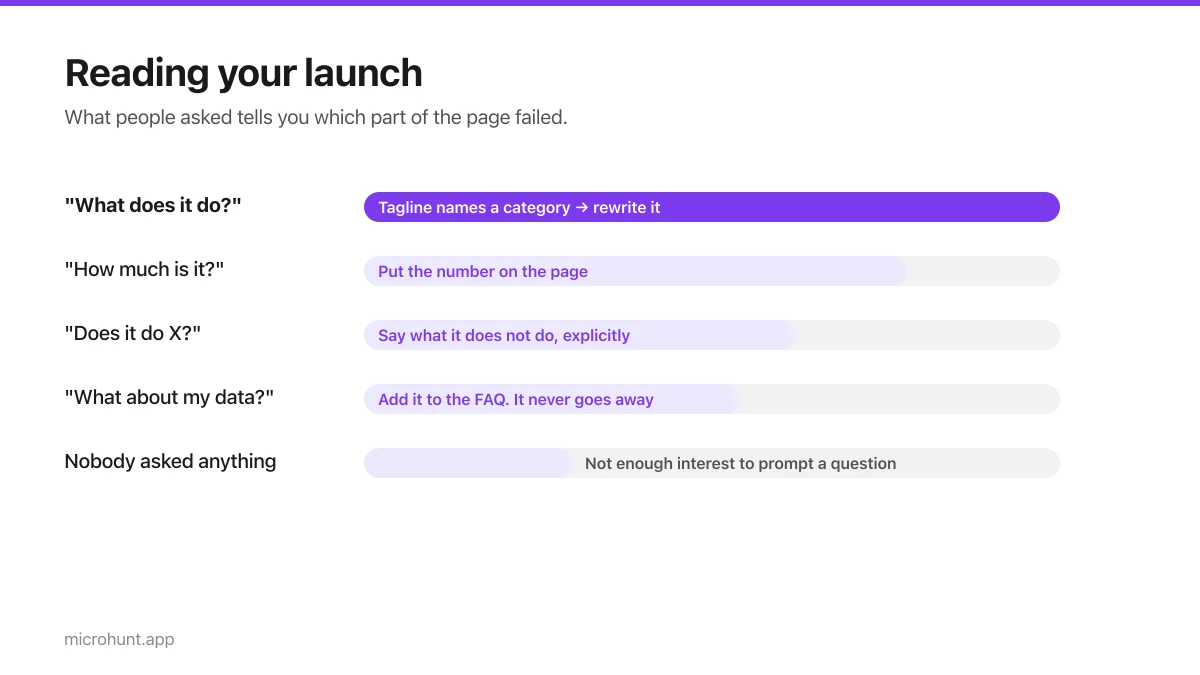
Every launch produces the same two or three misunderstandings. Those are not the readers' fault — they are copy problems, and you now have the data to fix them.
| What happened on launch day | What to change |
|---|---|
| People asked what it actually does | The tagline is describing a category. Rewrite it around the mechanism. |
| People asked about pricing repeatedly | Put the number on the page. Vagueness costs more than a high price. |
| People assumed a feature you do not have | Say what it does not do, explicitly, in the description. |
| People asked about data or privacy | Add it to the FAQ. This question never goes away. |
| Nobody asked anything | The page did not create enough interest to generate a question. Start with the tagline. |
Days four and five: ask for reviews
Reviews outlast launch traffic. Someone arriving at your listing in six months will care far more about three honest reviews than about where you finished on the day.
Ask the people who actually used the thing, individually, and do not offer anything in return — incentivised reviews are against our content policy and they read as fake to everyone else. There is more detail in how to collect product reviews.
Days six and seven: set up the long tail
- 1Update your listingThe version you launched with was a hypothesis. Update it with what you learned so the permanent page is the good version.
- 2Check your category placementIf the traffic came from people looking for something you did not expect, you may be in the wrong category.
- 3Write down what you would do differentlyYou will launch again. This note is worth more than any launch guide.
- 4Plan the next touchpointA changelog post, a follow-up in the same communities, an update to the listing when the next feature ships.
What good looks like
A launch that produced a badge and no conversations is worse than one that produced six emails from people describing exactly why they bounced. The second gives you a roadmap; the first gives you a graph.
If you are already planning the next one, the seven-day checklist is the front half of this cycle.
Frequently asked questions
- How long does launch traffic last?
- Typically two to three days of elevated traffic, then a decline to a low baseline that continues for months from search and category browsing. The baseline is what compounds; the spike is not.
- Should I update my listing after launching?
- Yes. The version you launch with is a hypothesis, and launch day tells you where it was wrong. The permanent page is what most people will eventually see, so it should be the improved version.
- What should I do if my launch flopped?
- Find out whether it was the product or the page. If people arrived and did not understand it, that is a copy problem you can fix in an afternoon. If they understood it and did not want it, that is more useful information than any badge.
- When should I relaunch?
- When something has meaningfully changed — a major feature, a new audience, a genuine repositioning. Relaunching the same product with the same page a month later mostly annoys the people who saw it the first time.
Keep reading
The Seven-Day Launch Checklist
A day-by-day plan for the week before you launch, weighted towards the things that actually change the outcome.
How to Collect Product Reviews People Will Believe
Reviews outlast launch traffic. Here is how to ask for them without incentivising, and why the mediocre ones help you.
Nine Launch Day Mistakes We See Every Week
The recurring problems that cost people a good launch, and what to do instead. Most of them are copy problems, not product problems.