How to Collect Product Reviews People Will Believe
6 min read
The short answer
Ask individual people who actually used the product, one at a time, shortly after they used it — and never offer anything in return. Incentivised reviews are against our content policy, and readers spot them instantly because they all sound the same. A page with three honest reviews including one lukewarm one converts better than ten uniformly glowing ones.
Launch traffic disappears in three days. Reviews sit on your page indefinitely, and they are what someone arriving in eight months will actually read. They are the most durable asset a launch produces and almost nobody works on them.
Ask individuals, not audiences
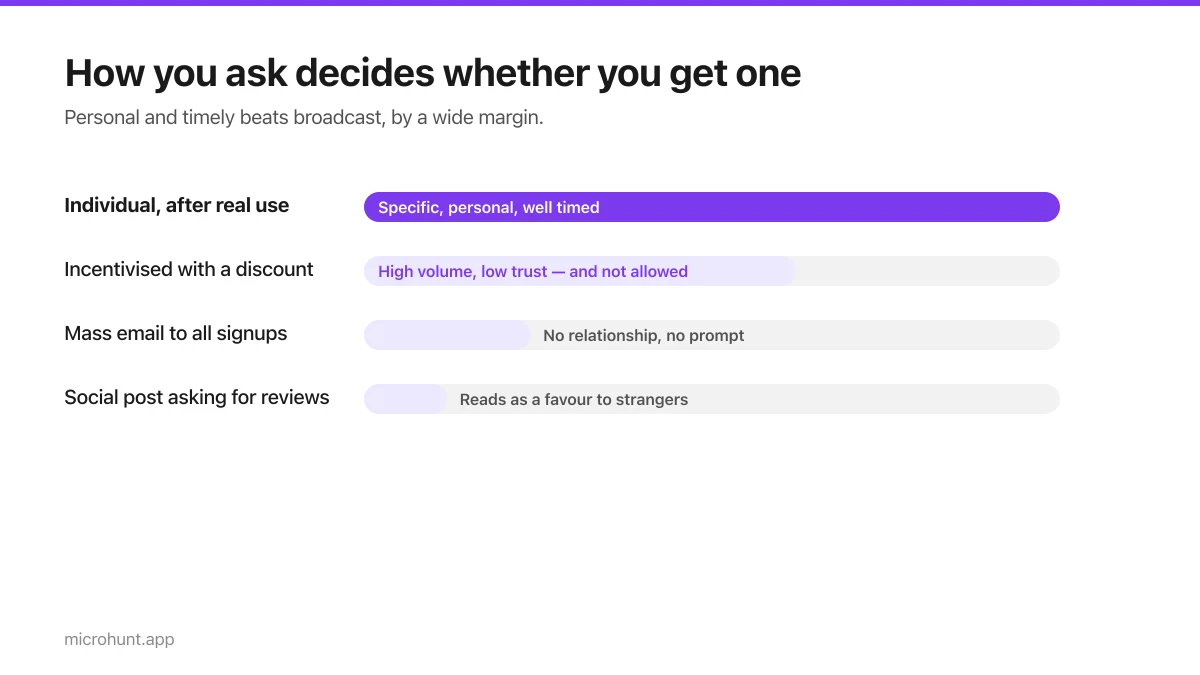
A broadcast request — "if you liked it, please leave a review!" — converts at close to nothing. An individual message to someone who you know used the thing converts remarkably well, because it is a real request from a real person about a specific experience.
| Approach | Typical result | Why |
|---|---|---|
| Mass email to all signups | Very low response | No relationship, no specific prompt |
| Social post asking for reviews | Near zero | Reads as a favour request to strangers |
| Individual message after real use | Good response | Specific, personal, timed well |
| Incentivised (discount for a review) | High volume, low trust | Readers discount them, and it breaks our rules |
Timing
The window is short. Ask shortly after someone has done the thing your product is for — finished the export, shipped the release, completed the first week. Ask a month later and they will not remember specifics, which produces the vague reviews nobody finds useful.
What to actually say
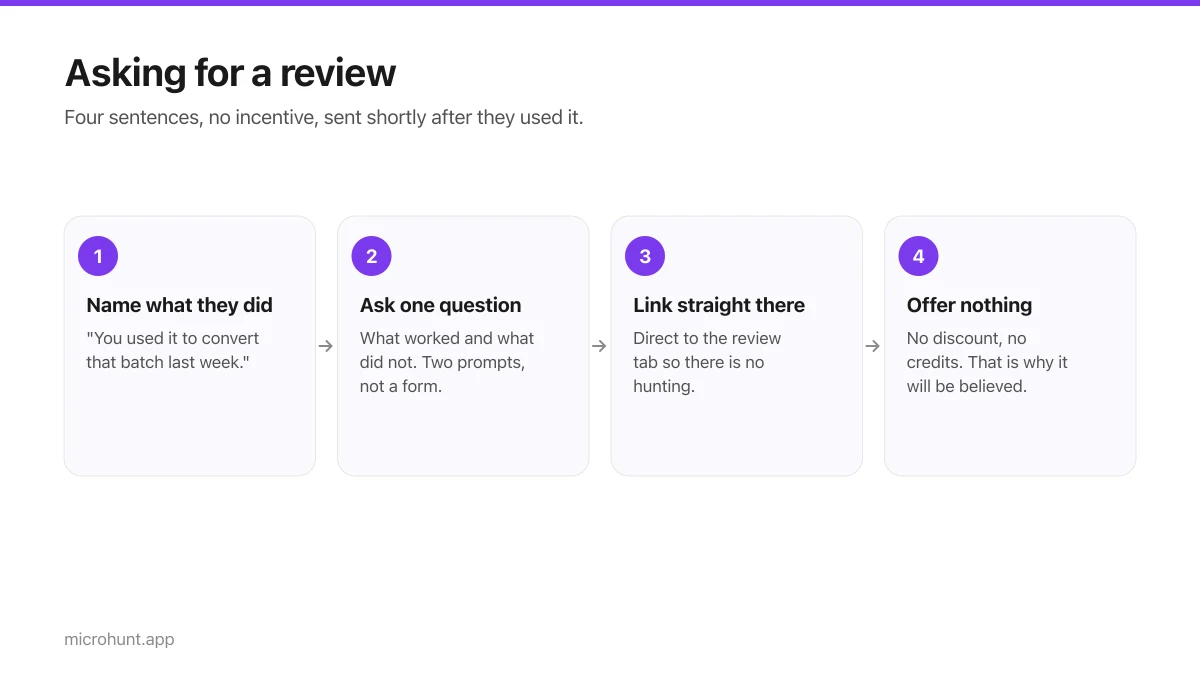
- 1Name the specific thing they did"You used it to convert that batch of files last week" — this jogs a real memory and produces a specific review.
- 2Ask one questionWhat worked and what did not. Two prompts, not a form.
- 3Say where it goesLink straight to your listing's review tab so there is no hunting.
- 4Offer nothingNo discount, no credits, no entry into a draw. This is both a rule and the reason the review will be believed.
The lukewarm reviews are doing work
A page with nothing but five-star reviews reads as curated, and readers discount the whole set. A four-star review that says "solid, but I wish it did X" makes every other review on the page more credible.
It also tells prospective users what the limits are, which means the people who sign up afterwards are better matched and churn less. A review that filters out a bad-fit customer has done you a favour.
Replying to reviews
- Reply to critical reviews first, and reply properly rather than defensively.
- If they identified a real gap, say so and say whether you plan to close it.
- If they misunderstood something, that is usually a documentation problem worth fixing.
- Do not argue. Everyone reading is judging your temperament as much as your answer.
Maker replies appear underneath the review on your listing with a Maker label, so readers can see you are engaged. That visible presence is worth more than the individual answers.
Frequently asked questions
- How do I get reviews for my product?
- Message individual people who actually used it, shortly after they used it, referencing the specific thing they did. Broadcast requests convert poorly; personal ones convert well.
- Can I offer a discount in exchange for a review?
- No. Incentivised reviews are against our content policy and get removed. They also read as bought to everyone else, which undermines the honest reviews on your page.
- Should I worry about a bad review?
- A mixed review makes the rest of your page credible, and it filters out badly matched customers before they sign up and churn. Reply to it properly — that reply is often more persuasive than the review is damaging.
- Do reviews affect ranking?
- No. Ranking on our boards is upvotes only. Reviews shape how people judge your product, which matters more over time, but they do not move you up a board.
Keep reading
What to Do the Week After Launch Day
The traffic spike is over. Here is how to turn a day of attention into something that lasts longer than the graph.
How Vuru Ranking Works (And How to Win a Badge)
Launch windows, upvotes, podium badges and what we do about vote manipulation — the whole ranking system explained plainly.
Nine Launch Day Mistakes We See Every Week
The recurring problems that cost people a good launch, and what to do instead. Most of them are copy problems, not product problems.