Nine Launch Day Mistakes We See Every Week
7 min read
The short answer
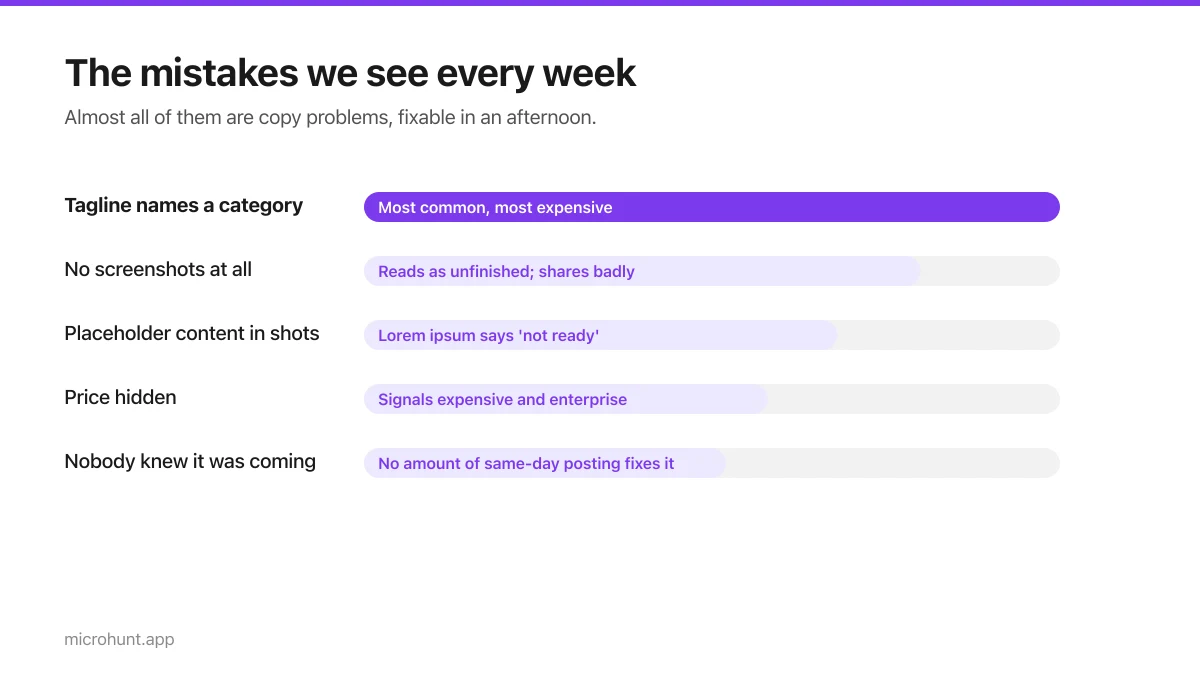
The most common launch mistake is a tagline that describes a category rather than a product, followed closely by launching with no screenshots and no FAQ. Almost every problem we see is a copy problem that could be fixed in an afternoon, not a product problem. Fix the first sentence before you touch anything else.
We see the same handful of problems over and over. None of them are about the product being bad — most of the products are fine. They are about the page failing to make the product legible in the four seconds it gets.
1. A tagline that names a category
By some distance the most common and most expensive mistake. If your line would read perfectly well with a competitor's name in it, it is describing a market, not a product. Fix this first — everything else is downstream. The method is in how to write a product tagline.
2. No screenshots
A listing with no images gets a generated placeholder, and it reads as unfinished regardless of how good the product is. Even one real screenshot changes this completely. It also becomes your social preview, so a listing without one shares badly everywhere.
3. Screenshots full of placeholder content
Lorem ipsum, empty states, and demo accounts called "Test User" all say the same thing to a reader: this is not finished. Populate your demo data properly before you screenshot it. It takes twenty minutes and it is the highest-return twenty minutes available on launch day.
4. Hiding the price
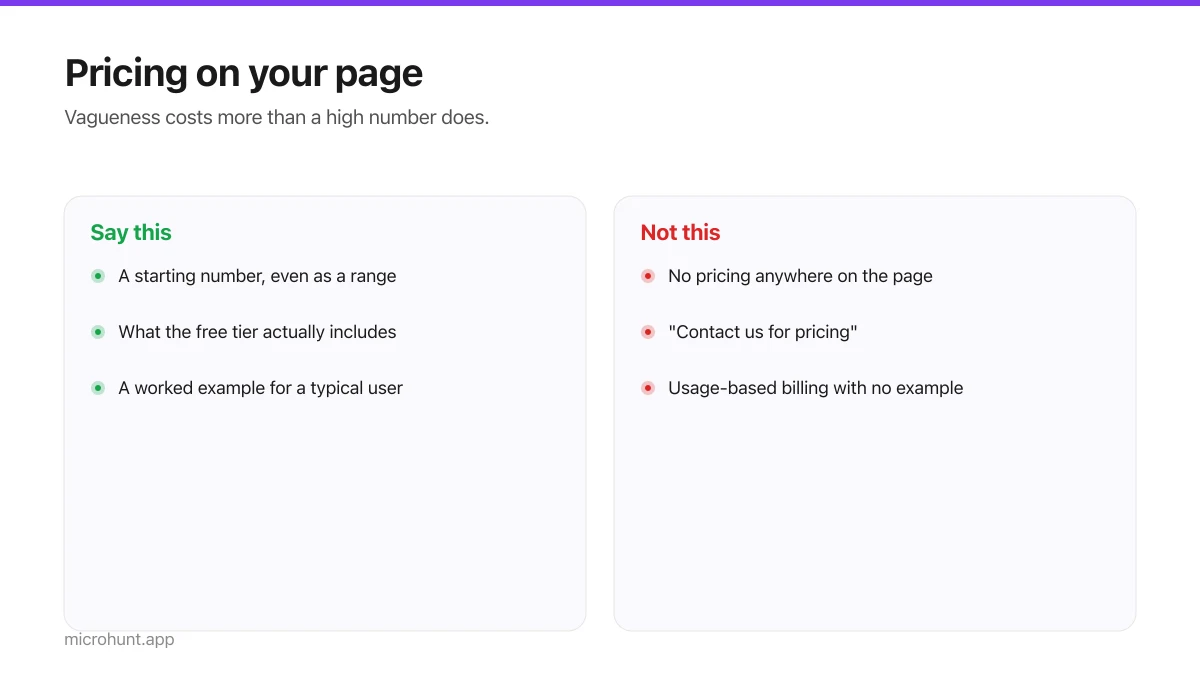
| What people do | What it signals | What to do |
|---|---|---|
| No pricing anywhere | Probably expensive, probably enterprise | State it, even as a range |
| "Contact us for pricing" | You will be qualified and upsold | Give a starting number |
| Free with no mention of limits | There is a catch coming | Say what the free tier includes |
| Complex usage pricing, unexplained | You cannot predict your bill | Give a worked example for a typical user |
5. Launching with nobody expecting it
The single biggest determinant of how a day goes is whether anyone knew you were coming. Arriving cold on launch day is the hardest version of the game, and no amount of same-day promotion substitutes for three weeks of being present somewhere. See building an audience before launch.
6. Posting the same blurb everywhere at once
Fifteen identical posts in one afternoon reads as spam to every community that receives one, and moderators talk to each other. Three tailored posts across three weeks outperform it comfortably.
7. Going quiet in the comments
A thread where the maker is answering keeps resurfacing and keeps converting. A thread where three questions sat unanswered for six hours does neither. If you cannot be available on the day, move the day.
8. Treating the launch as the finish line
The traffic spike lasts two or three days. The listing lasts years. Makers who update their page afterwards with what they learned get a compounding trickle from search; makers who never touch it again get a stale snapshot of launch day forever. What to do after launch day covers this properly.
9. Chasing votes instead of users
Vote-swap groups, incentivised voting and multiple accounts all produce a bigger number and no customers. We remove accounts for it, but the practical problem is worse than the enforcement: you end up with a badge, an empty funnel, and no idea whether anyone actually wants the thing.
The short version
- Rewrite the tagline until it describes a mechanism.
- Add at least three real screenshots with real content.
- Put the price on the page.
- Fill in the FAQ, including the awkward questions.
- Tell people beforehand, then answer everything on the day.
Do those five and you will be ahead of most launches. When you are ready, submit your product.
Frequently asked questions
- Why did my product launch fail?
- Usually because the page did not make the product legible quickly enough, not because the product was wrong. If people arrived and asked what it does, that is a tagline problem. If nobody arrived at all, that is an audience problem, and both are fixable.
- Should I launch without screenshots?
- No. A listing without images reads as unfinished and shares badly, because the first screenshot doubles as your social preview. One real screenshot of the working product is enough to change this.
- Is it bad to launch on multiple platforms?
- Not at all — it is recommended. What hurts is posting identical copy to many places on the same day. Stagger them and rewrite for each audience.
- What if I get negative comments?
- Answer them properly and publicly. A considered reply to a real criticism builds more trust than any number of positive comments, because it shows readers you are honest about the product's limits.
Keep reading
The Seven-Day Launch Checklist
A day-by-day plan for the week before you launch, weighted towards the things that actually change the outcome.
What to Do the Week After Launch Day
The traffic spike is over. Here is how to turn a day of attention into something that lasts longer than the graph.
How to Write a Product Tagline That Actually Gets Clicked
The one line most people will ever read about your product, and a simple test for whether yours is doing any work.