How to Write a Product Tagline That Actually Gets Clicked
7 min read
The short answer
A good tagline says what the product mechanically does, in one specific sentence, using the words your user would use. Test it by swapping in a competitor's name — if the sentence still makes sense, it is too generic to be doing anything. Aim for eight to twelve words and cut every adjective that survives a first draft.
In a feed, your product is a small logo, a name, and one line of text. That line decides whether anyone clicks. Everything else on your page — the screenshots you agonised over, the feature list, the FAQ — only gets seen by people the tagline already convinced.
It follows that the tagline deserves more of your time than it usually gets. Most makers spend an afternoon on the landing page design and four minutes on the sentence that determines whether anyone sees it.
The swap test
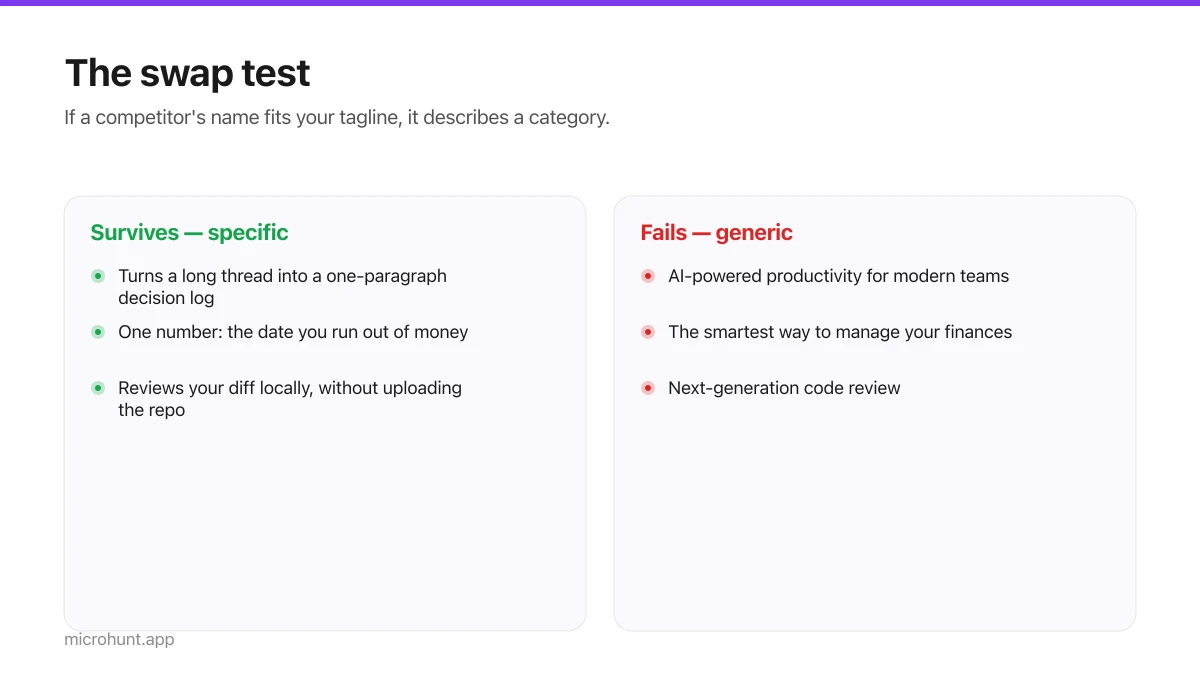
Here is the fastest way to know if your tagline is working. Take your sentence and swap your product's name for a competitor's. If it still reads perfectly well, your tagline is describing a category, not a product.
| Generic | Specific |
|---|---|
| AI-powered productivity for modern teams | Turns a long thread into a one-paragraph decision log |
| The smartest way to manage your finances | One number: the date you run out of money at current burn |
| Beautiful design tools for creators | Pulls a full colour system out of any screenshot |
| Effortless scheduling for busy professionals | Books meetings without the four-email back and forth |
| Next-generation code review | Reviews your diff locally, without uploading the repo |
Lead with the mechanism, not the benefit
Marketing advice often says to sell the benefit rather than the feature. In a feed, that advice backfires. Benefits are abstract and all sound alike — save time, stay aligned, work smarter. Mechanisms are concrete and immediately tell someone whether they want it.
"Save hours on meeting notes" is a benefit. "Writes the follow-ups from your meeting transcript" is a mechanism, and the second one lets a reader decide in half a second.
Use your user's words, not your industry's
The vocabulary you have developed while building is not the vocabulary your user searches with. We see this constantly on submissions: a tool described in the language of its own architecture rather than the problem it solves.
- "Vector-based semantic retrieval over local documents" → "Search every PDF you have downloaded, by meaning"
- "Unified observability platform" → "Find the slow query before your users complain"
- "Async collaboration layer" → "Replaces your daily standup with 90 seconds of video"
Length
Eight to twelve words is the range that works in a feed. Under six usually means you have said a category name rather than a sentence. Over about fifteen and it truncates on a phone, which is where most people will read it.
Check the truncation yourself. Open your category board on a narrow window and see where your line cuts off. If the informative half is the half that disappears, rewrite it front-loaded.
A workable process
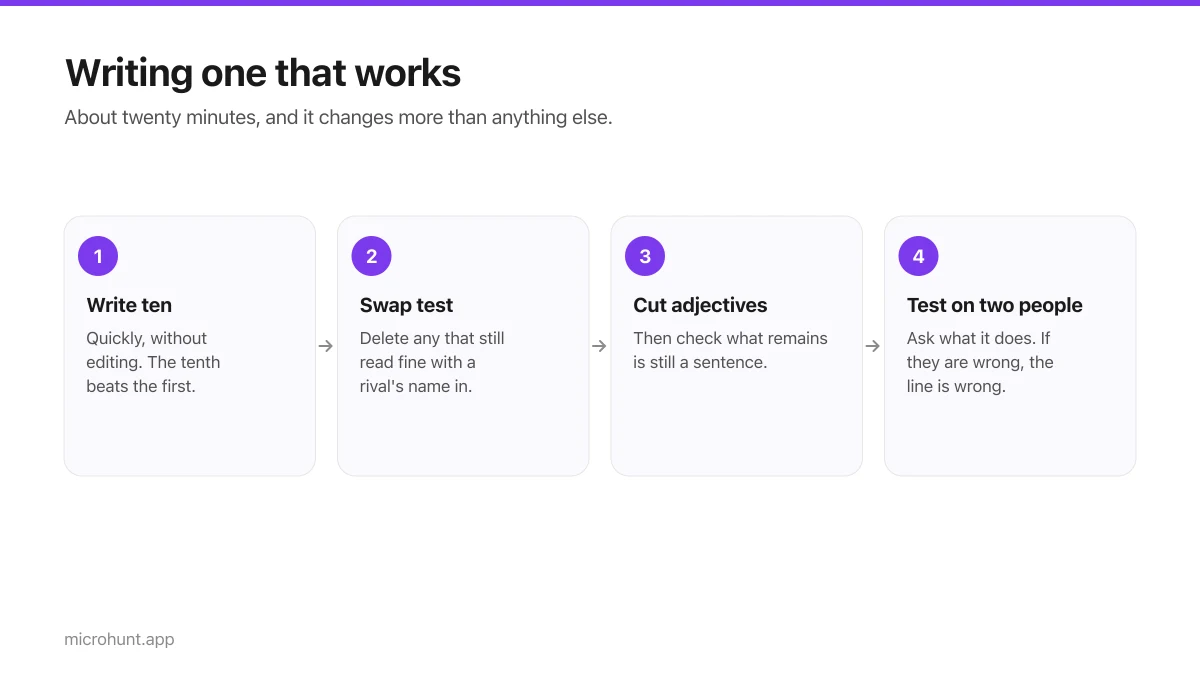
- 1Write ten, quicklyDo not edit as you go. The tenth is usually better than the first because you have exhausted the obvious phrasings.
- 2Run the swap test on eachDelete every one that survives having a competitor's name dropped in.
- 3Cut the adjectivesFrom whatever survives. Then read what is left and check it is still a sentence.
- 4Show two people who do not know the productAsk them what they think it does. If they are wrong, it is the tagline's fault, not theirs.
- 5Check it on a phoneIn the actual feed, at actual width, with your actual logo next to it.
When you have one you are happy with, it goes in the tagline field on the submit form — and the same sentence should be the first thing on your own landing page.
Frequently asked questions
- How long should a product tagline be?
- Eight to twelve words is the practical range for a feed. Shorter tends to mean you have named a category rather than described a product, and much longer truncates on mobile where most people read it.
- Should a tagline describe the feature or the benefit?
- In a feed, the mechanism wins. Benefits are abstract and interchangeable across competitors, while a concrete mechanism lets someone decide immediately whether they want it.
- Can I change my tagline after launching?
- Yes, and you should if it is not landing. The tagline you launch with is a hypothesis. If people consistently misunderstand what the product does, that is data about the sentence, not about them.
- What is the swap test?
- Replace your product name with a competitor's in your tagline. If the sentence still reads fine, your tagline describes a whole category rather than your specific product, and it is not doing any work for you.
Keep reading
How to Submit a Product on Vuru (Step by Step)
A walk through the submission form, what each field does to your page, and the fields most people leave empty that they shouldn't.
How to Get Your First Upvotes Without Begging
What actually generates early votes, why vote-for-vote groups do not work, and the approach that keeps paying off after launch day.
Product Page SEO: A Practical Checklist
The things that actually matter on a product page, in the order worth doing them, without the audit-tool noise.