Product Page SEO: A Practical Checklist
8 min read
The short answer
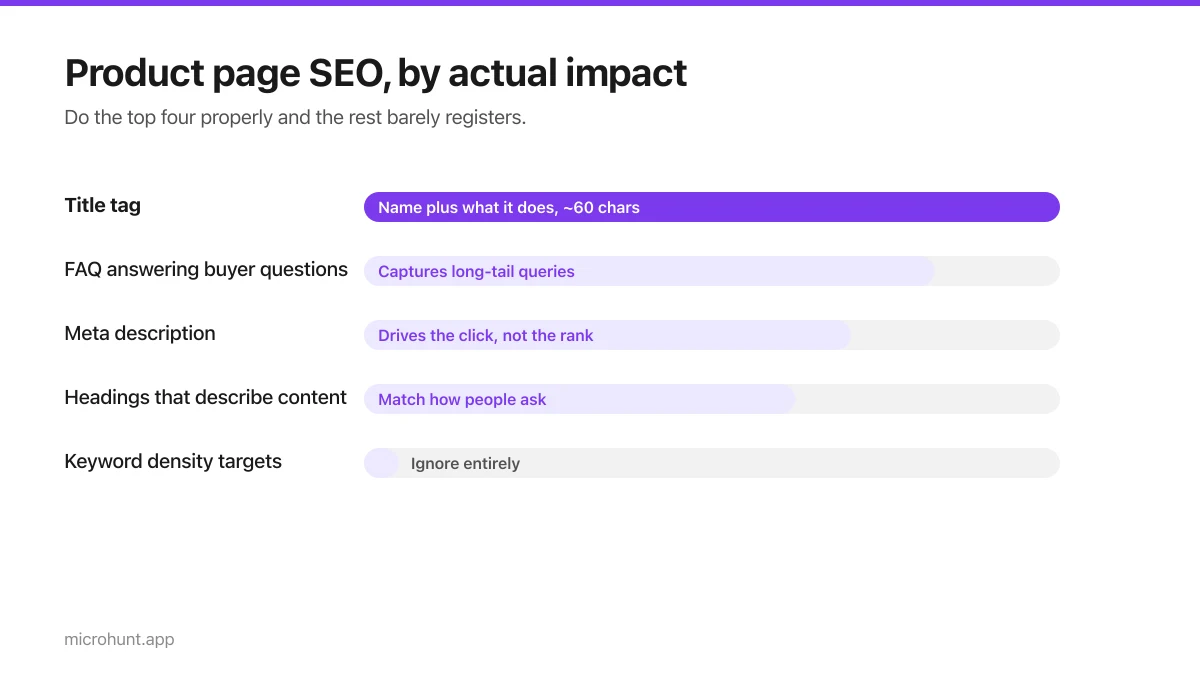
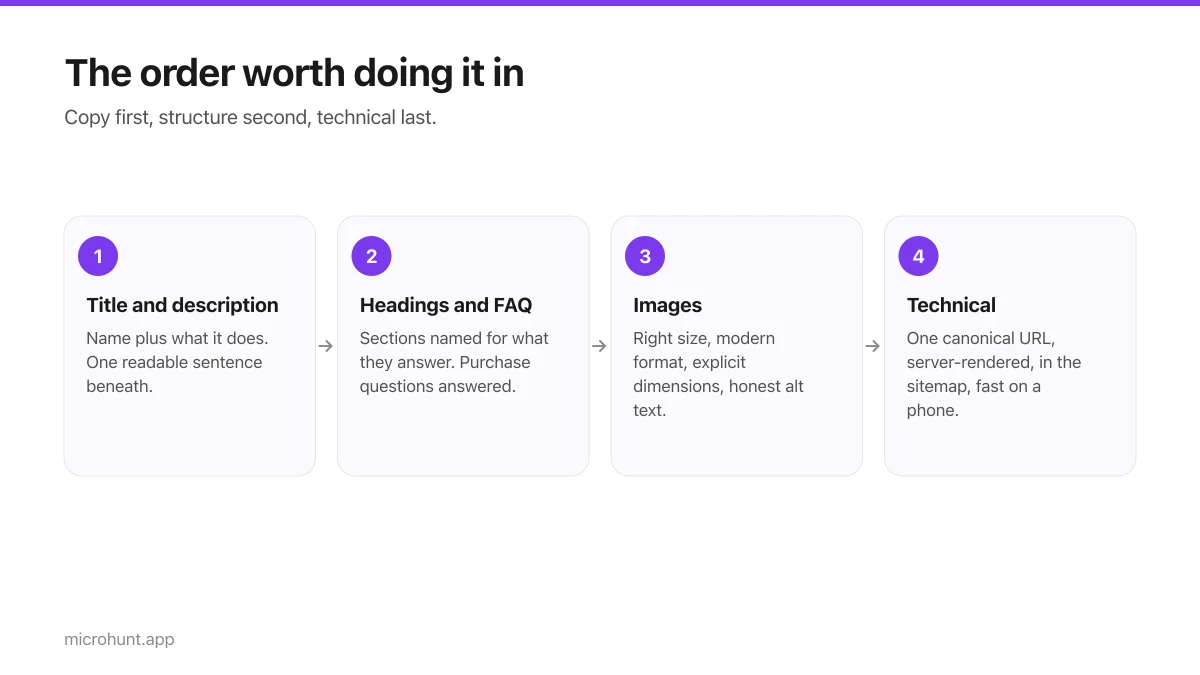
Get four things right and you have done most of product page SEO: a title that names the product and what it does, a description that reads like a person wrote it, real headings with an FAQ answering purchase questions, and images that load fast with honest alt text. Everything else on a typical audit report is a rounding error by comparison.
Audit tools produce long lists, most of it noise. This is the short version: what genuinely moves a product page, roughly in the order worth doing it.
1. The title tag
Your product name plus what it does, in about sixty characters. The name alone wastes the most valuable text on the page; a keyword-stuffed title reads like spam to the humans deciding whether to click.
| Weak | Better |
|---|---|
| Threadloom | Threadloom — turn long threads into decision logs |
| Best AI Meeting Tool | Notes | Transcription | 2026 | Notewell — meeting notes that write their own follow-ups |
| Home | Runway Left — see the date your startup runs out of money |
2. The meta description
It does not affect ranking directly and it heavily affects whether anyone clicks. Write it as a sentence a person would read, include what the product does, and keep it near 155 characters so it is not cut off.
3. Headings that describe content
One H1 that matches what the page is about, then H2s that name what each section actually covers. "Features" is a weak heading. "What it does with your existing files" is a strong one, because it matches how someone would ask.
4. An FAQ answering purchase questions
The highest-return section on most product pages, and the most commonly skipped. Answer what people ask before they commit: pricing and its limits, data handling, platform support, what happens when they stop paying, and how you compare to the obvious alternative.
These are the exact long-tail queries people search, and a plainly answered question is also the most quotable thing on your page — see getting cited by AI assistants.
5. Images that load and describe themselves
- Modern formats, sized to how they are displayed rather than uploaded at full resolution.
- Explicit width and height so the layout does not shift while loading.
- Lazy loading below the fold, eager loading for the first image.
- Alt text describing what the image shows — not a keyword list.
- One social preview image so shares do not look broken.
6. Structured data
Product, Offer, AggregateRating, FAQPage and BreadcrumbList cover almost everything a product page needs. Mark up only what is genuinely on the page — invented ratings are a fast route to a manual penalty.
7. The technical minimum
- 1One canonical URLPick a form and stick to it. Duplicate pages at multiple URLs split whatever authority you have.
- 2Server-rendered contentIf the copy only appears after JavaScript, some crawlers will not see it.
- 3In the sitemapWith an accurate lastmod, and linked from somewhere a crawler can reach.
- 4Fast on a phoneMost people arrive on mobile. Test on a real connection, not a fast desktop one.
What to ignore
Keyword density targets, meta keywords, exact-match anchor text obsession, and most of the yellow warnings in an audit tool. If your page loads quickly, says clearly what the product does, and answers the questions a buyer has, you have done the part that matters.
If you are filling in a listing here, the submit form maps onto this checklist directly — the tagline becomes the title, the description becomes the meta description, and the FAQ field is section four.
Frequently asked questions
- What is the most important thing on a product page for SEO?
- The title tag — your product name plus what it does, in about sixty characters. It is the most valuable text on the page for both ranking and click-through.
- Do meta descriptions affect ranking?
- Not directly, but they strongly affect whether someone clicks your result, which matters. Write one readable sentence around 155 characters rather than a keyword list.
- Should I add structured data to a product page?
- Yes — Product, Offer, AggregateRating and FAQPage cover most needs. Only mark up what genuinely appears on the page; fabricated ratings risk a manual penalty.
- How long should a product description be?
- Long enough to answer what it does, who it is for and what it costs — usually two or three paragraphs. Length itself is not a ranking factor; padding a short answer makes the page worse.
- Does page speed matter for product pages?
- Yes, particularly on mobile where most visitors arrive. Correctly sized modern-format images with explicit dimensions fix the majority of speed problems on a typical product page.
Keep reading
Getting Cited by AI Assistants: What Actually Works
More people are asking an assistant instead of searching. Here is what makes a page quotable rather than summarised away.
Do Launch Platforms Still Help Your SEO?
What a launch listing is actually worth for search, what it is not worth, and why the permanent page matters more than the spike.
How to Submit a Product on Vuru (Step by Step)
A walk through the submission form, what each field does to your page, and the fields most people leave empty that they shouldn't.