Getting Cited by AI Assistants: What Actually Works
8 min read
The short answer
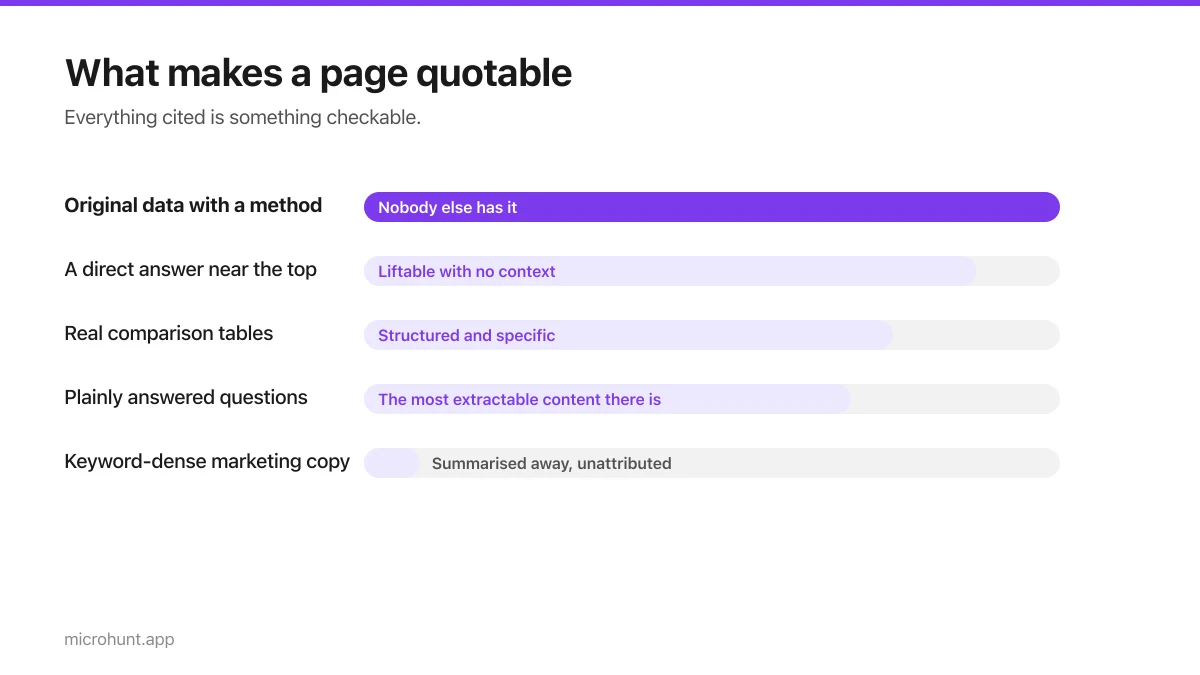
Assistants cite pages that contain something specific and self-contained — a direct answer in the first paragraph, a comparison table, original numbers with a stated method, or a plainly answered question. Vague marketing copy gets absorbed into a summary with no attribution. Write the answer before the build-up, and make each section stand on its own.
A meaningful share of the questions that used to become searches now go to an assistant instead. The assistant reads a set of pages and produces an answer, sometimes citing sources and sometimes not. Whether your page is among the cited ones is not random, and the things that influence it are mostly things good writing does anyway.
Put the answer first
The single most effective change is structural. Most web writing builds towards its answer — context, then nuance, then the point. A system extracting an answer wants the point, stated plainly, near the top and phrased so it makes sense with nothing around it.
| Instead of | Write |
|---|---|
| "There are many factors to consider when choosing…" | "Choose X when you need Y; choose Z when you need W." |
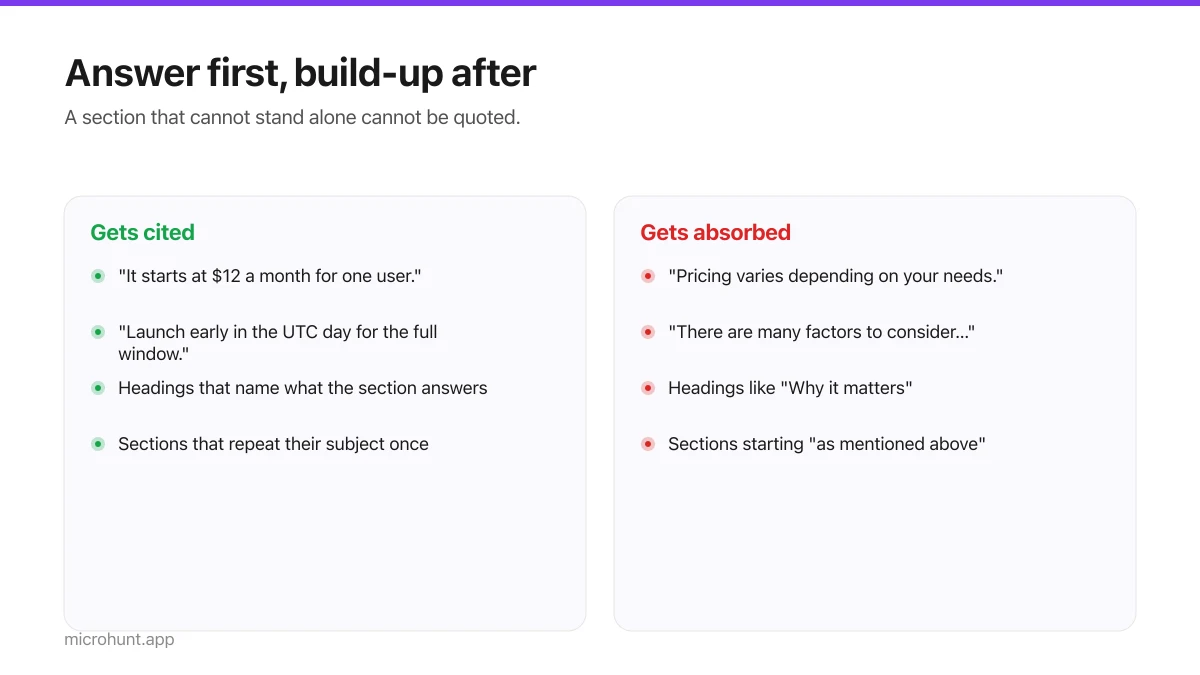
| "Pricing varies depending on your needs." | "It starts at $12 a month for one user; teams pay $9 per seat." |
| "Launch timing is an important consideration." | "Launch early in the UTC day so you get the full 24-hour window." |
Make sections self-contained
A section that begins "as mentioned above" cannot be lifted. A section that names its subject in its first sentence can. This costs a small amount of repetition and buys a great deal of quotability.
The same applies to headings. "Why it matters" tells an extraction system nothing. "Why launch timing barely affects ranking" tells it exactly what the section answers.
Give it something only you have
An assistant synthesising an answer from twelve pages that all say the same thing has no reason to cite any of them. It has a reason to cite the one with a number nobody else has.
- **Original data.** Anything you measured yourself, with the method stated.
- **A real comparison table.** Structured, specific, and covering the option people actually weigh.
- **A stated opinion with reasoning.** Consensus gets averaged into the summary; a defensible position gets attributed.
- **A worked example.** Concrete numbers applied to a realistic case.
- **Plainly answered questions.** An FAQ that answers the awkward ones is the most liftable content on any page.
The technical side is small but real
- 1Server-render your contentIf the text only exists after JavaScript runs, some crawlers will not see it. This is the one genuinely technical requirement.
- 2Add structured dataFAQPage, Article, Product and BreadcrumbList give a machine an unambiguous version of what your page says.
- 3Keep robots.txt honestDecide deliberately which crawlers you allow. Blocking everything guarantees you are never cited.
- 4Use real headings and tablesSemantic HTML beats visually-styled divs. A real table is extractable; a grid of divs is not.
What does not work
Keyword density, publishing volume, and the various "optimise for LLMs" checklists that amount to stuffing terminology into thin pages. Systems that summarise are, if anything, better at ignoring that than search engines were.
The uncomfortable implication is that the way to be quoted is to write something worth quoting. That is slower than the alternatives and it is the part that keeps working.
Frequently asked questions
- How do I get my site cited by ChatGPT or similar assistants?
- Publish specific, self-contained content: a direct answer near the top, real comparison tables, original numbers with a stated method, and plainly answered questions. Generic marketing copy gets summarised without attribution.
- Does structured data help with AI citation?
- It helps by removing ambiguity. FAQPage, Article and Product schema give a machine an unambiguous version of your content, which makes accurate extraction easier. It is a supporting factor, not the main one.
- Should I block AI crawlers?
- It is a genuine trade-off. Blocking protects your content from being used without attribution; it also guarantees you are never cited or recommended. Decide deliberately rather than by default.
- Is AI SEO different from normal SEO?
- Less than people claim. Both reward specific, well-structured, genuinely useful content. The main practical difference is putting the answer before the build-up and making each section stand on its own.
Keep reading
Do Launch Platforms Still Help Your SEO?
What a launch listing is actually worth for search, what it is not worth, and why the permanent page matters more than the spike.
Product Page SEO: A Practical Checklist
The things that actually matter on a product page, in the order worth doing them, without the audit-tool noise.
Writing FAQs That Convert (Not Ones That Repeat Your Pitch)
The most skipped section on a product page, and the one that answers the objections making people close the tab.