Writing FAQs That Convert (Not Ones That Repeat Your Pitch)
7 min read
The short answer
Write the questions people actually ask before buying, including the awkward ones — pricing limits, data handling, what is missing, and what happens if they stop paying. FAQs that repeat marketing copy convert nothing, while ones that answer real objections do more than another paragraph of positioning. They are also the most quotable part of your page for search and AI assistants.
The FAQ is the most-skipped field on our submission form and the one we would most like people to fill in. It is also the section most often filled in badly, with questions invented to give the marketing copy another outing.
The test for a real question
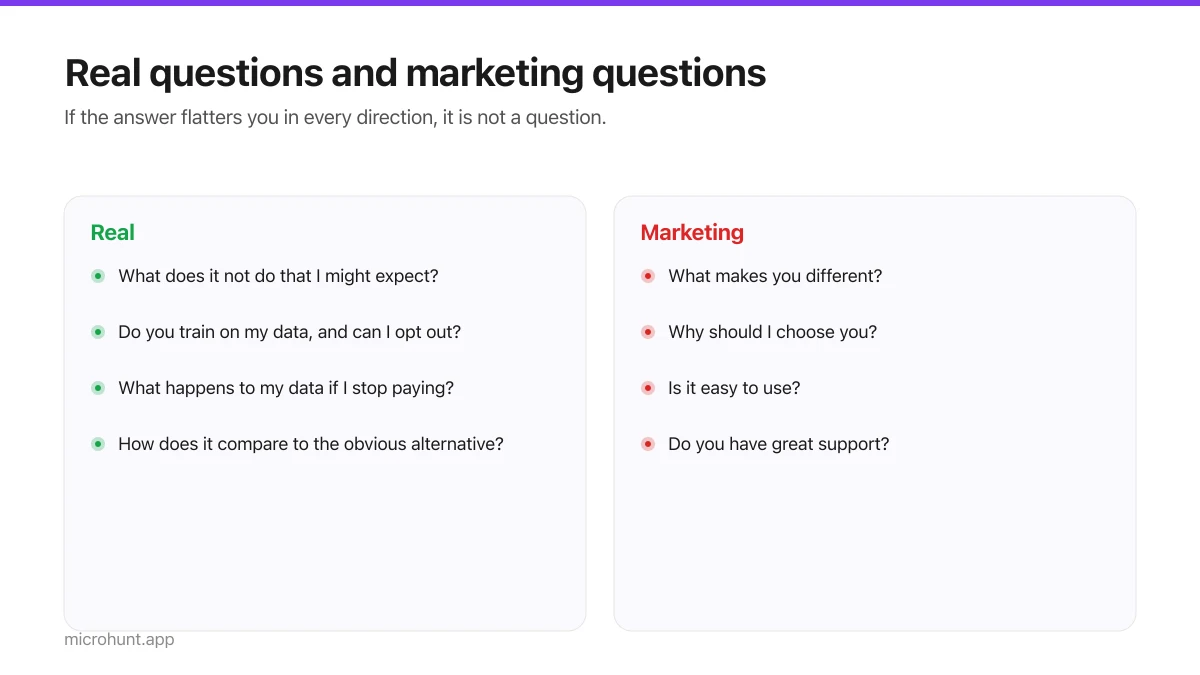
A real FAQ answers something that could stop a purchase. If the answer is flattering in every direction, it is not a question — it is a feature bullet wearing a question mark.
| Fake question | Real question |
|---|---|
| What makes you different? | What does it not do that I might expect? |
| Why should I choose you? | How do you compare to the obvious alternative? |
| Is it easy to use? | How long before I get something useful out of it? |
| Is my data safe? | Do you train on my data, and can I opt out? |
| Do you have great support? | What happens to my data if I stop paying? |
The five that apply to almost everything
- **What does it cost, and what does the free tier actually include?** The single most searched question about any product.
- **What happens to my data?** Where it is stored, whether you train on it, and how someone gets it out or deleted.
- **What is missing?** Platforms you do not support, integrations you do not have, the thing people keep asking for.
- **Who is it not for?** Counter-intuitively increases conversion, because the people it is for become more certain.
- **What happens if I stop paying?** Export, read-only access, or deletion. Silence here reads as the worst option.
How to answer
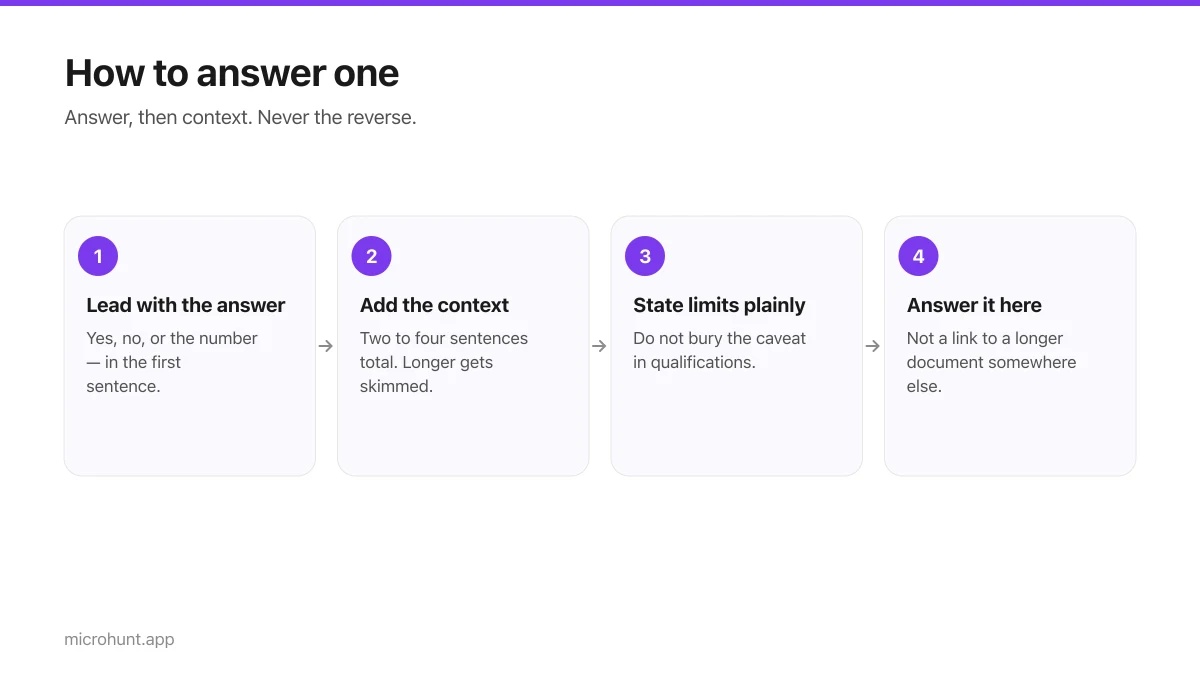
Directly, in the first sentence, then elaborate if needed. An answer that opens with "Great question!" or spends a sentence restating the question has wasted the only part anyone reads.
- Lead with the answer: yes, no, or the number.
- Two to four sentences. Longer answers are skimmed and lose the point.
- Say the limitation plainly rather than burying it in qualifications.
- No links to a longer document as the answer. Answer it here.
Why this doubles as your best SEO
The questions people ask before buying are the exact long-tail queries they type into a search box: "is X free", "X vs Y", "does X work offline". A page that answers them plainly can rank for all of them without a single dedicated article.
It is also the most extractable content you own. A clean question-and-answer pair is the easiest thing for an assistant to lift and attribute — which is the mechanism described in getting cited by AI assistants. Marked up as FAQPage schema, it is unambiguous to a machine as well as readable to a person.
How many
Four to eight is the useful range. Fewer and you have not covered the objections; more and it becomes a support document that nobody scrolls. If you find yourself with twenty, the top five belong on the product page and the rest belong in your docs.
On a listing here they go in the Details step of the submit form, one per line as Question | Answer.
Frequently asked questions
- What questions should a product FAQ answer?
- The ones that could stop a purchase: what it costs and what the free tier includes, what happens to your data, what the product does not do, who it is not for, and what happens if you stop paying.
- How many FAQs should a product page have?
- Four to eight. Fewer leaves objections unanswered; more turns the section into a support document people scroll past. Keep the purchase-blocking ones on the page and move the rest to docs.
- Do FAQs help SEO?
- Substantially. The questions buyers ask are the long-tail queries they search, so a well-answered FAQ can rank for many of them at once. Marked up as FAQPage schema it is also the most extractable content on your page.
- Should I include negative information in an FAQ?
- Yes. Saying what the product does not do and who it is not for increases conversion, because it makes the people it does suit far more confident, and it filters out badly matched customers before they churn.
Keep reading
Product Page SEO: A Practical Checklist
The things that actually matter on a product page, in the order worth doing them, without the audit-tool noise.
Getting Cited by AI Assistants: What Actually Works
More people are asking an assistant instead of searching. Here is what makes a page quotable rather than summarised away.
How to Submit a Product on Vuru (Step by Step)
A walk through the submission form, what each field does to your page, and the fields most people leave empty that they shouldn't.