Do Launch Platforms Still Help Your SEO?
8 min read
The short answer
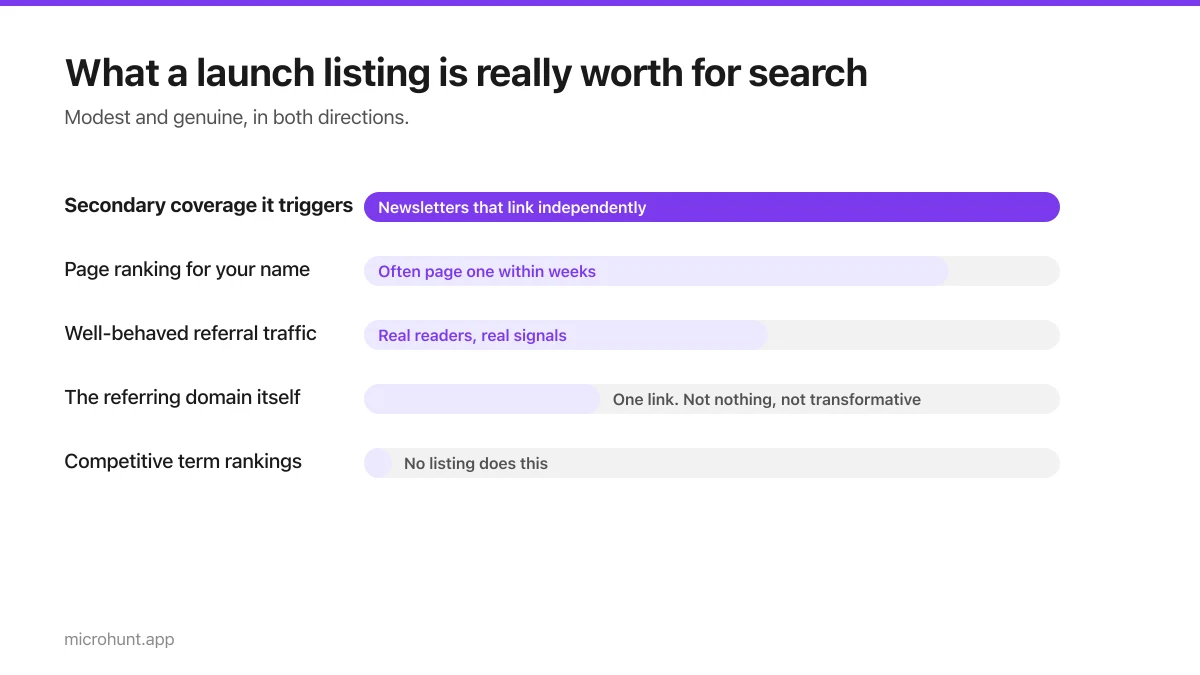
A launch listing helps search in three modest, real ways: an indexed page that ranks for your product name, a referring domain, and a burst of mentions that often produce genuine links elsewhere. It will not rank you for competitive terms and it is not a link-building strategy. Treat the permanent listing as the asset and the launch-day traffic as a bonus.
Two claims circulate about launch platforms and search, and both are wrong. The first is that a listing is a powerful SEO play worth optimising your whole launch around. The second is that directory links are worthless spam. The truth is duller and more useful than either.
What you actually get
| What | Worth | Why |
|---|---|---|
| An indexed page for your product name | Genuinely useful | Ranks for branded searches, often on page one within weeks |
| A referring domain | Modest | One link from an established domain. Not nothing, not transformative |
| Secondary coverage | The real prize | Newsletters and blogs that pick up your launch link to you independently |
| Traffic that behaves well | Indirect | Real visitors who read and click send better signals than bought traffic |
| Ranking for competitive terms | Nothing | No listing will rank you for a term people fight over |
The branded search page is underrated
When someone hears your product name from a friend and searches for it, they see your site — and then several other results. What those results say shapes whether they trust you enough to click through.
A well-filled listing with real screenshots, a clear description and a few genuine reviews is a good second result. An empty listing with a placeholder logo is a bad one. Since the page will rank for your name regardless, it is worth making it the version you would want a prospective customer to read.
Nofollow, and why it matters less than people think
Many directory and user-submitted links carry nofollow or sponsored attributes, which means search engines treat them as hints rather than endorsements. People conclude the link is worthless. That misses two things.
- **Traffic is traffic.** A nofollow link that sends real people who read your page and come back is worth more than a followed link nobody clicks.
- **Links beget links.** The value of a launch is rarely the listing link itself — it is the newsletter writer who saw it and wrote about you, and their link is usually followed.
What has changed with AI summaries
A growing share of searches end in a summary rather than a click. That has two consequences worth planning around.
First, thin content aimed only at ranking gets absorbed and returns nothing. Pages that exist to occupy a keyword now compete with a system that will read them, summarise them, and not send the visitor. Second, and more usefully, the pages that get quoted are the ones containing something specific — a number, a comparison table, a plainly answered question. We wrote about this properly in getting cited by AI assistants.
What not to do
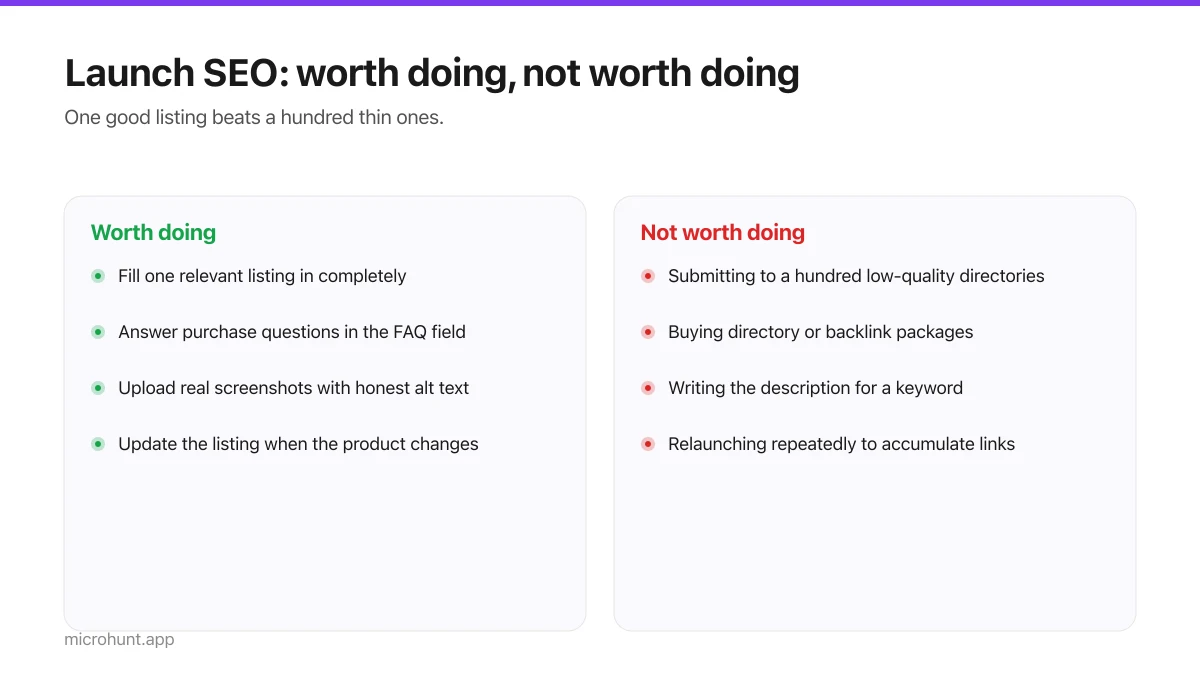
- Do not submit to a hundred low-quality directories. It is the pattern spam detection was built for, and it burns time you could spend on one good listing.
- Do not buy directory packages. The links are worthless and the associations are not helpful.
- Do not write your listing description for a keyword. It is read by people deciding whether to click, and stuffed copy reads exactly like stuffed copy.
- Do not relaunch repeatedly hoping for link accumulation. It annoys the audience and does nothing for search.
A sensible expectation
For most independent products, a good launch produces one indexed listing that ranks for the product name, one referring domain, a handful of secondary mentions of varying quality, and a slow trickle of traffic that continues for years. That is a decent return for an afternoon of filling in a form properly.
It is not a search strategy. If you want to rank for the terms your buyers search when they do not know you exist, that is a longer piece of work — start with the product page SEO checklist.
Frequently asked questions
- Does a Product Hunt or launch board listing help SEO?
- Modestly and genuinely. You get a page that ranks for your product name, one referring domain, and often secondary coverage that links to you independently. It will not rank you for competitive terms.
- Are directory links nofollow?
- Many are. That reduces their direct ranking value but not their usefulness — real visitors who read your page send better signals than any link attribute, and launch coverage often produces followed links elsewhere.
- Should I submit to lots of directories for SEO?
- No. Mass directory submission is the exact pattern spam detection targets, and the links carry no value. One well-filled listing on a relevant board is worth more than a hundred thin ones.
- How long does a launch listing keep sending traffic?
- Years, at a low level. The spike lasts days but the indexed page keeps appearing in branded searches and category browsing, which is why keeping it updated is worth the occasional five minutes.
Keep reading
Product Page SEO: A Practical Checklist
The things that actually matter on a product page, in the order worth doing them, without the audit-tool noise.
Getting Cited by AI Assistants: What Actually Works
More people are asking an assistant instead of searching. Here is what makes a page quotable rather than summarised away.
Best Product Hunt Alternatives for Launching in 2026
Where else to launch when Product Hunt is not the right fit — what each platform is actually good at, who shows up, and what it costs.