Where to Launch an AI Product (When Everyone Else Is Too)
8 min read
The short answer
AI products face more competition on launch boards than any other category, so differentiation carries the entire launch. Say what your model does that a general assistant cannot, be specific about where inference runs and what it costs at real volume, and lead with a mechanism rather than the word AI. The launches that work read like tools that happen to use a model, not like models looking for a use.
Look at any launch board on any given day and a large share of what is posted involves a model somewhere. That is the context your launch lands in, and it changes the job. You are not explaining what AI can do — everyone reading already knows. You are explaining why yours is worth opening a tab for.
The word AI is doing no work
Two years ago "AI-powered" was a differentiator. Now it describes most of the page, which means it carries no information at all. The tagline that gets clicked describes the mechanism instead: what goes in, what comes out, and what that saves.
| Says AI | Says what it does |
|---|---|
| AI-powered writing assistant | Fixes LaTeX compile errors as you write |
| Intelligent meeting companion | Writes the follow-up emails from your transcript |
| AI code review platform | Reviews your diff locally, without uploading the repo |
| Smart document search | Answers with the page and paragraph it came from |
| Next-gen AI agent | Books the meeting, then stops and asks before paying |
Answer the three questions everyone now asks
This audience has used enough AI tools to have developed reflexes. Three questions come up on nearly every AI launch we see, and answering them on the page rather than in the comments changes how the day goes.
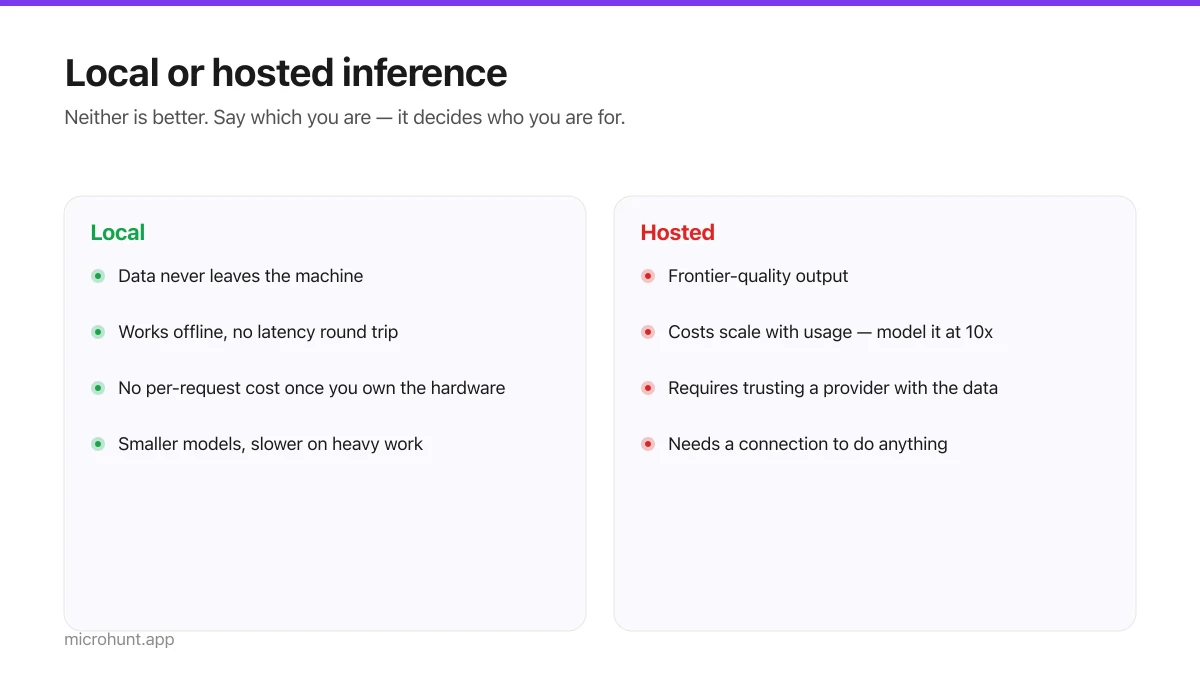
- 1Where does inference run?On my machine or on your server. This decides privacy, offline use and cost, and people want it stated plainly rather than inferred from a diagram.
- 2Do you train on my data?The only good answers are a clear no, or a clear yes with an opt-out that is on by default. Silence reads as yes.
- 3What does it cost at real volume?Flat fee, pass-through tokens, or bring your own key. A tool that feels cheap at ten documents can be ruinous at a thousand.
Where to actually post
The general advice in our platform guide applies, with one adjustment: for AI tools the technical communities are harsher and more valuable than the general boards.
| Where | How it goes | Worth it for |
|---|---|---|
| Hacker News | Sceptical, technical, sometimes brutal | Anything with real engineering behind it; local-first especially |
| Launch boards | Crowded with similar products | A permanent page and a broad first look |
| Niche subreddits | Depends entirely on the sub's rules | Tools for a specific profession or workflow |
| Model and ML communities | Interested in method, not marketing | Novel technique, benchmarks, open weights |
| Vuru | Categorised, permanent, quieter | Being findable later by someone browsing AI tools |
What differentiates in practice
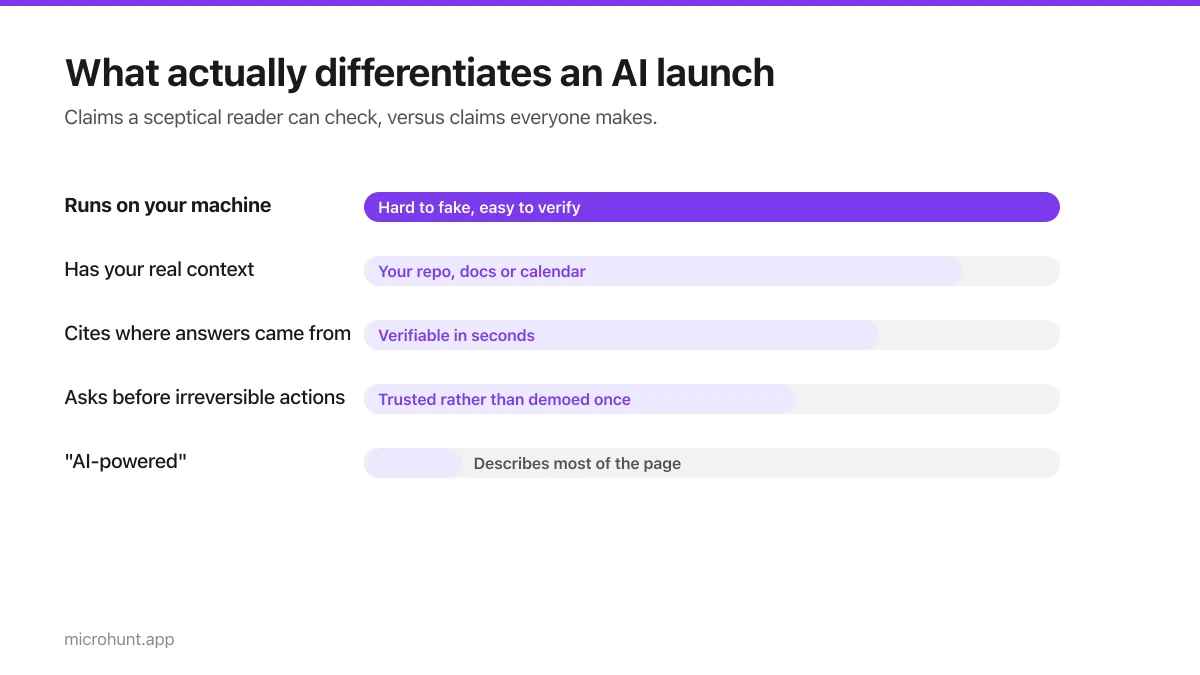
Having watched a lot of these launches now, the ones that stand out share a small number of traits. None of them are about the model.
- **It runs locally.** Genuinely hard to fake, immediately meaningful, and technical users will verify it.
- **It has real context.** A tool that reads your whole repository, your actual documents, or your real calendar beats a general assistant that has none of it.
- **It cites its source.** Anything that shows where an answer came from is more useful than something marginally more accurate that does not.
- **It stops before doing something irreversible.** Agents that ask before spending money or sending email are trusted; ones that do not are demoed once.
- **It is narrow.** "An AI for everything" competes with the frontier labs. "An AI for fixing LaTeX errors" does not.
The demo problem
AI demos are unusually easy to make look good and unusually easy to disbelieve, because everyone has seen a cherry-picked one. The most persuasive thing you can do is show a case where the output is imperfect and explain how the tool handles it.
That single piece of honesty buys more credibility than a reel of best-case results, because the question in a sceptical reader's mind is not whether it can work — it is what happens when it does not.
A note on benchmarks
If you publish numbers, publish the method with them. An accuracy figure with no description of the dataset, the baseline, or who evaluated it is treated as marketing, and rightly so. A smaller honest number with a reproducible method is worth more than a large one nobody can check.
When you are ready, the mechanics are the same as any launch — the seven-day checklist covers the preparation, and the differentiation work above is what goes into the tagline.
Frequently asked questions
- Is it harder to launch an AI product now?
- Harder to stand out, not harder to launch. The category is the most crowded on every board, so the tagline and the specific mechanism carry far more weight than they would elsewhere.
- Should I mention AI in my tagline?
- Usually not. It describes most of the page and therefore distinguishes nothing. Describe what the tool does mechanically — if that involves a model, readers will work it out.
- Where is the best place to launch an AI tool?
- Depends on who it serves. Technical tools do well on Hacker News and developer communities. Profession-specific tools do better in that profession's own spaces. General boards give you reach and a permanent page but heavy competition.
- Do people care whether inference runs locally?
- A specific and growing group cares a lot — anyone handling sensitive documents, code or client data. It is one of the few claims in this category that is genuinely hard to fake, which is why it differentiates.
- What should I put in my FAQ for an AI product?
- Where inference runs, whether you train on user data, and what it costs at realistic volume. Those three questions come up on nearly every AI launch, and answering them on the page converts better than answering them in comments.
Keep reading
Best Product Hunt Alternatives for Launching in 2026
Where else to launch when Product Hunt is not the right fit — what each platform is actually good at, who shows up, and what it costs.
How to Write a Product Tagline That Actually Gets Clicked
The one line most people will ever read about your product, and a simple test for whether yours is doing any work.
The Seven-Day Launch Checklist
A day-by-day plan for the week before you launch, weighted towards the things that actually change the outcome.