Launching Solo vs Launching With a Team
6 min read
The short answer
Solo launches win on authenticity and lose on coverage — one person cannot answer comments across five channels for twelve hours. Plan for that by launching in fewer places and being genuinely present in each, rather than spreading thin. Teams should decide who owns replies before the day starts, because a thread with three inconsistent voices reads worse than one with a single honest maker.
Launch advice is usually written as though a team exists. Most launches we see come from one person, sometimes two, and the differences are worth planning around rather than ignoring.
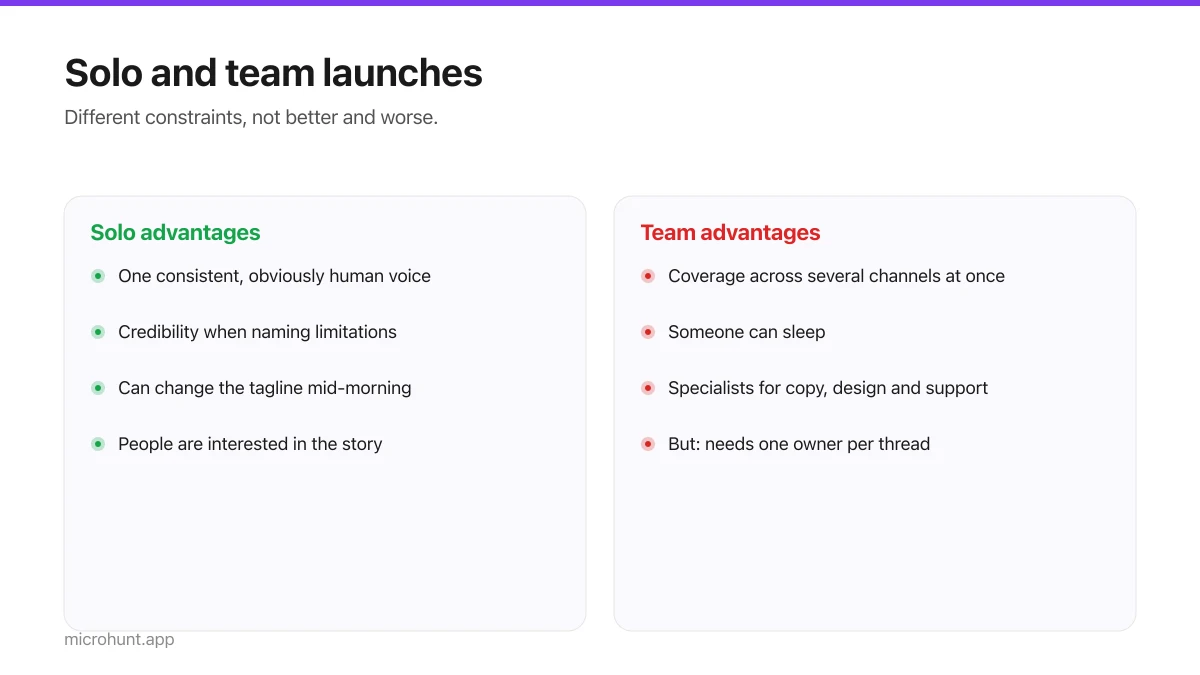
What solo makers have that teams do not
A single, consistent, obviously human voice. People respond to it, and it cannot be manufactured. A thread where one person is honestly answering every question — including the awkward ones — builds trust in a way that a coordinated team presence rarely does.
- **Credibility on limitations.** "I have not built that yet" from the person who built it lands completely differently from a company saying it is on the roadmap.
- **Speed.** You can change the tagline mid-morning because it clearly is not working. No approval, no discussion.
- **The story.** People are interested in one person building a thing. It is not a strategy but it is a real advantage.
- **Consistency.** One voice across every reply, which no team achieves without effort.
The constraint that actually bites
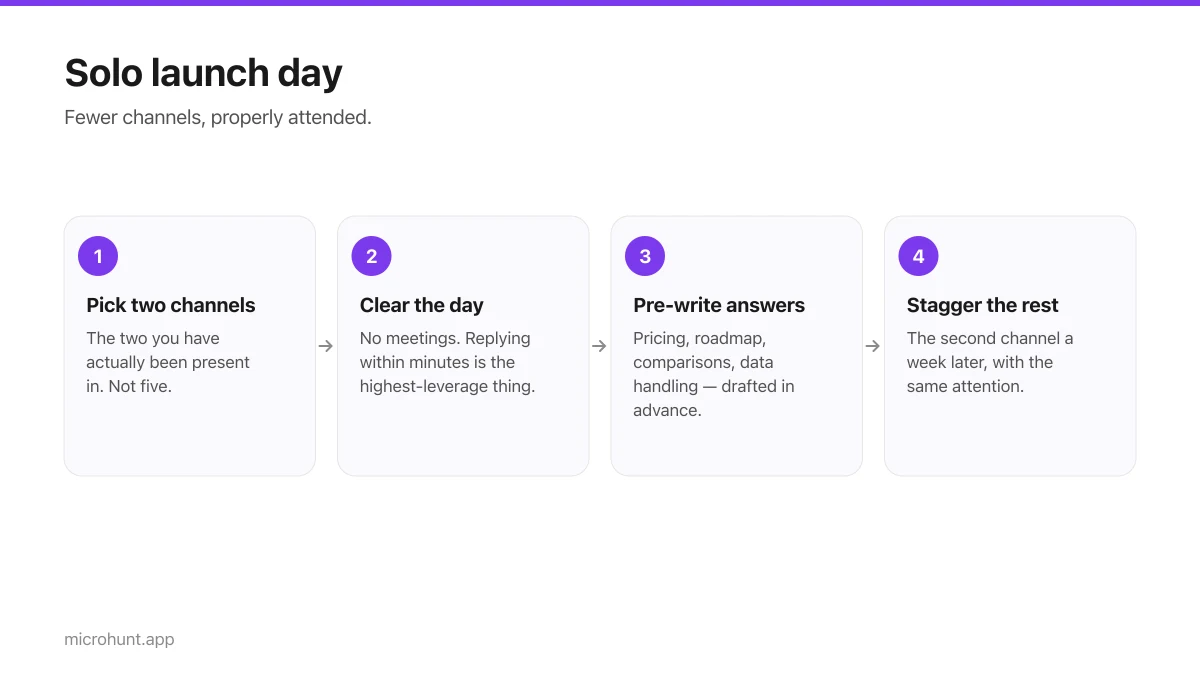
Coverage. Launch day rewards being present and answering quickly, and one person cannot sustain that across five channels for twelve hours. The failure mode is predictable: spread across everything, respond slowly everywhere, and the threads that could have taken off go quiet.
The fix is not to work harder on the day. It is to launch in fewer places on purpose.
- 1Pick two channels, not fiveWhichever two you have actually been present in. Being properly available in two beats being absent in five.
- 2Clear the dayDo not launch on a day with meetings. Replying within minutes is the highest-leverage thing available.
- 3Pre-write the repeated answersPricing, roadmap, comparisons, data handling. Have them drafted so you can adapt rather than compose.
- 4Stagger instead of stackingThe second channel a week later, when you can give it the same attention.
If you are a team
The team failure mode is the mirror image: enough capacity to be everywhere, and no agreement about who says what. Three people answering the same question three slightly different ways is worse than one person answering it once.
- **One person owns replies** on each channel. Others can help, but one voice per thread.
- **Agree the awkward answers beforehand.** Pricing, the missing feature, the competitor comparison.
- **Decide who can commit to a roadmap item.** A support reply promising a feature becomes a promise.
- **Post as a person, not the company account.** A named maker replying outperforms a brand voice consistently.
The part that is identical
Everything before launch day. The tagline, the screenshots, the FAQ, the weeks of being present somewhere — none of that changes with headcount, and all of it matters more than how many of you there are.
A solo maker with a specific tagline and three real screenshots will out-launch a team with vague positioning every time. The preparation is in the seven-day checklist, and it is the same list either way.
Frequently asked questions
- Can a solo maker launch successfully?
- Yes, and solo launches have real advantages — a consistent human voice, credibility when discussing limitations, and the ability to change things instantly. The constraint is coverage, which is solved by launching in fewer places.
- How many channels should a solo maker launch on?
- Two, chosen from places you have already been present. Being genuinely available in two beats being slow to respond in five, and you can always stagger the others a week later.
- Should I say I am a solo founder?
- If it is relevant, yes — people are interested and it makes your honesty about limitations more credible. Using "we" is also fine and normal; inventing colleagues or testimonials is not.
- What should a team decide before launch day?
- Who owns replies on each channel, what the answers are to the awkward questions, and who is allowed to commit to a roadmap item. Inconsistent replies from several people read worse than one honest voice.
Keep reading
The Seven-Day Launch Checklist
A day-by-day plan for the week before you launch, weighted towards the things that actually change the outcome.
How to Get Your First Upvotes Without Begging
What actually generates early votes, why vote-for-vote groups do not work, and the approach that keeps paying off after launch day.
Building an Audience Before You Launch (Without a Big Following)
You do not need thousands of followers. You need thirty people who know what you are building — here is how that actually happens.