Choosing the Right Category for Your Launch
6 min read
The short answer
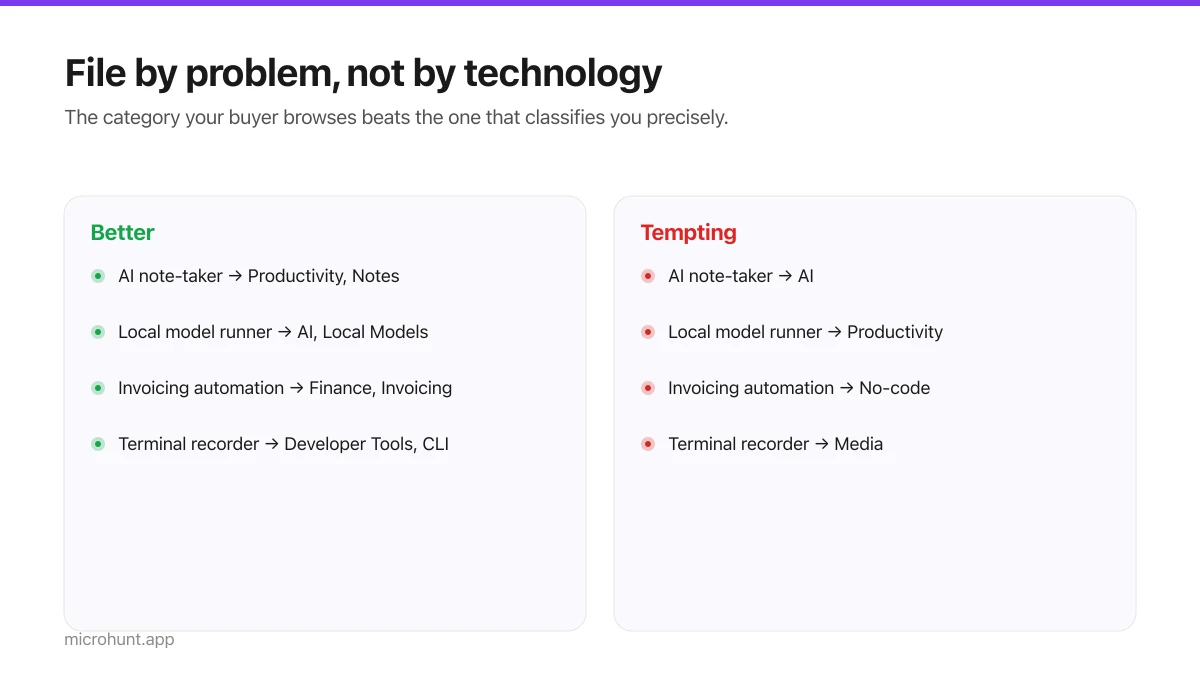
Pick the category your buyer would browse, not the one that most accurately classifies your technology. A note-taking app built with AI belongs in Productivity if it competes with note apps, and in AI only if people are shopping for AI tools. When two fit, choose the less crowded one — being findable in a small category beats being invisible in a large one.
Category feels like an administrative field and behaves like a positioning decision. It determines which board you appear on, who browses past you for the next several years, and what a visitor assumes you compete with before they read a word.
Classify by buyer, not by technology
The most common mistake is filing by what the product is built with rather than what it is for. A meeting-notes tool that uses a model is not an AI product to the person buying it — it is a meetings product that happens to work well.
| Product | Tempting | Better | Why |
|---|---|---|---|
| AI note-taker | AI | Productivity → Notes | Competes with note apps, not models |
| Local model runner | Productivity | AI → Local Models | Buyers are shopping for exactly this |
| Invoicing with automation | No-code | Finance → Invoicing | Buyer has an invoicing problem |
| Screenshot-to-palette tool | AI | Design → Colour | Designers browse Design |
| Terminal recorder | Media | Developer Tools → CLI | Audience is developers |
The test
Imagine the person you want. They have the problem, they have not heard of you, and they are browsing. Which board are they on? That is your category. It is not always the one that describes your product most precisely, and precision is not the goal — being found is.
Use the subcategory
Our categories nest, so you can sit in something specific while still appearing on the broader board. "Local Models" is a much better home than "AI" if that is what you are, because someone browsing it has already told you what they want.
When two genuinely fit
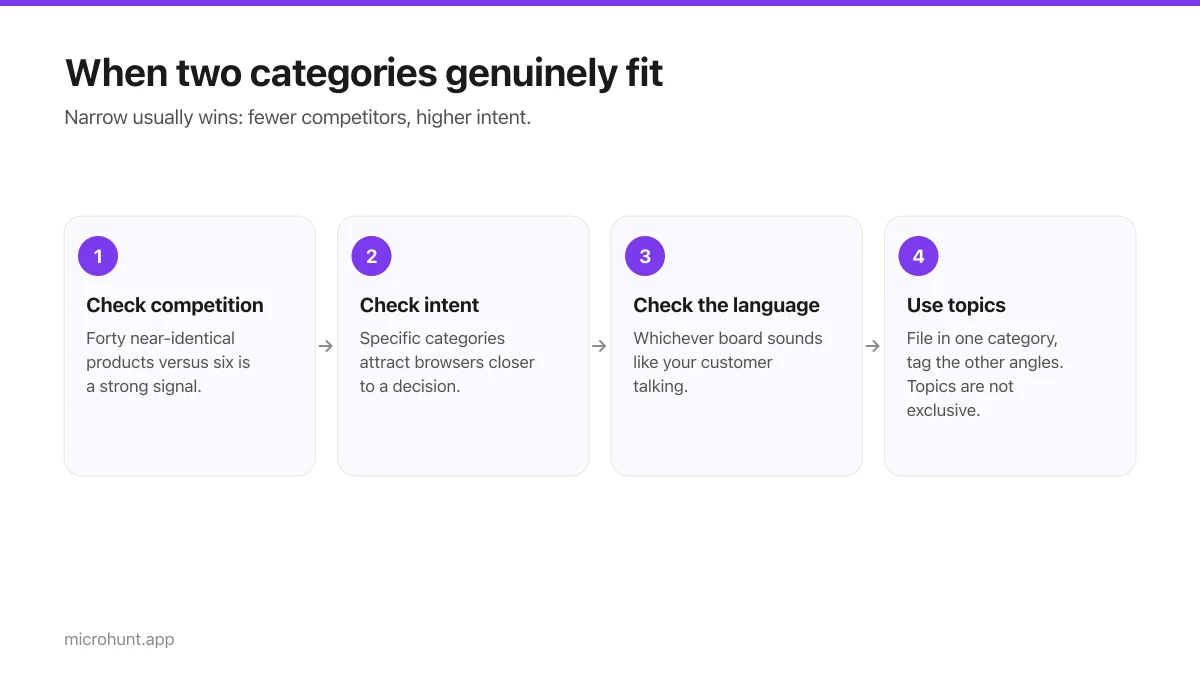
- 1Check the competitionLook at both boards. If one has forty near-identical products and the other has six, that is a strong signal.
- 2Check the intentWhich board's browsers are closer to a decision? Specific categories attract people further along.
- 3Check the languageRead the taglines on both boards. Whichever sounds like your customer talking is the right one.
- 4Use topics for the restTopics are not exclusive. File in one category and tag the other angles.
It is not permanent
If launch traffic arrives from people expecting something different, that is a category signal as much as a copy signal. Moving is cheap; being in the wrong place for a year is not.
Topics do the work that a second category would. Two or three on the submit form let you show up for the angles that are not your primary home, without diluting where you actually sit.
Frequently asked questions
- How do I choose a product category?
- Pick the one your buyer would browse when they have the problem and have not heard of you. That is often not the category that most precisely classifies the technology you built with.
- Should I pick a broad or narrow category?
- Narrow, when one genuinely fits. A specific subcategory has fewer competitors and browsers with higher intent, and products in a subcategory still appear on the parent board.
- Can a product be in more than one category?
- One category, plus topics. Topics are not exclusive, so file where your buyer looks and use topics for the other angles you want to be found for.
- Can I change my category later?
- Yes, and you should if launch traffic arrives from people expecting something else. Being in the wrong category for a year costs far more than moving does.
Keep reading
How to Submit a Product on Vuru (Step by Step)
A walk through the submission form, what each field does to your page, and the fields most people leave empty that they shouldn't.
How to Write a Product Tagline That Actually Gets Clicked
The one line most people will ever read about your product, and a simple test for whether yours is doing any work.
Best Product Hunt Alternatives for Launching in 2026
Where else to launch when Product Hunt is not the right fit — what each platform is actually good at, who shows up, and what it costs.