Launching a Consumer App When Launch Boards Are Full of Founders
7 min read
The short answer
Launch boards skew heavily towards makers and founders, so a consumer app will get encouragement there and few real users. The people who install a habit tracker or a recipe app are in niche communities and short video, not on maker boards. Post to the board for the permanent listing, and find your users where they already talk about the problem.
The most common disappointment we see is a consumer product having a decent day on a launch board and getting almost no retained users from it. The traffic was real. The audience was other people who build software, and they downloaded it to see how it was made.
Who is actually on a launch board
Overwhelmingly: founders, developers, designers, investors, and people who enjoy seeing new products. That is a wonderful audience for a developer tool and a poor one for a meal planner, because they are not experiencing the problem your app solves.
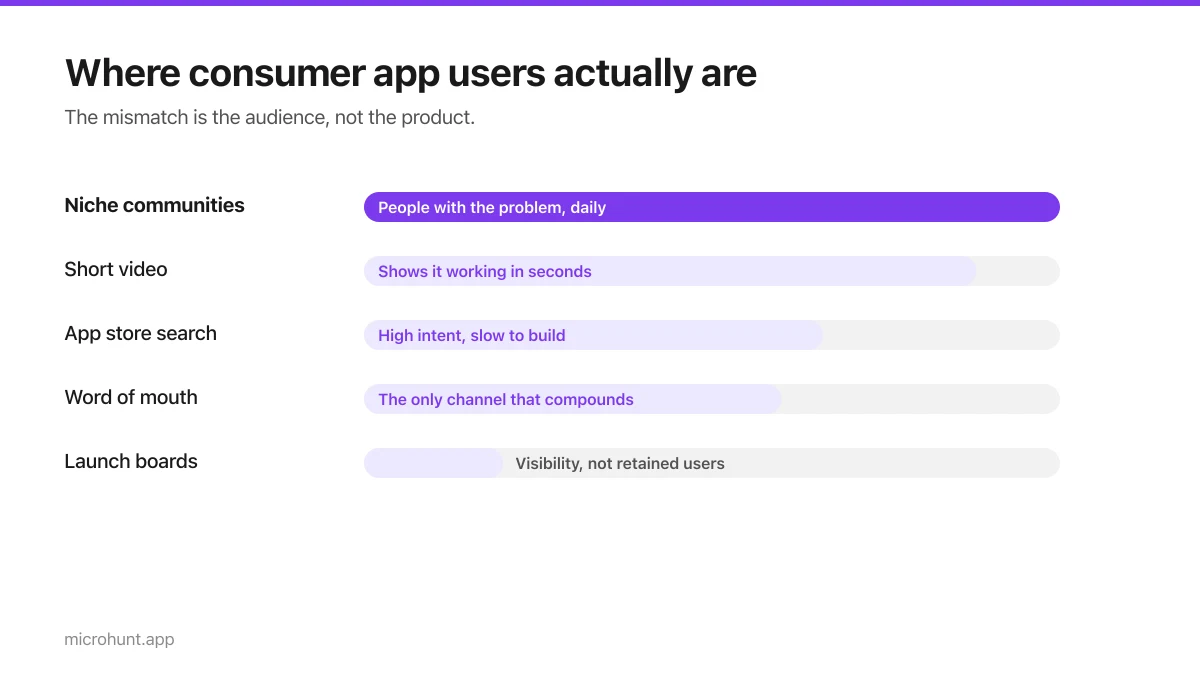
Where consumer users actually come from
| Channel | Why it works | The cost |
|---|---|---|
| Niche communities | People discussing the exact problem, daily | Weeks of genuine participation first |
| Short video | Shows the app working in seconds; algorithmic reach | You have to actually make video |
| App store search | High intent — they are looking for this | Slow, and store optimisation is its own craft |
| Word of mouth | The only channel that compounds | Requires the app to be genuinely good |
| Launch boards | A permanent page, a backlink, some visibility | Almost no retained users |
Short video is the honest answer for most
It is not a fashionable recommendation and it is usually the correct one. Consumer apps are visual and quick to demonstrate, which is exactly what short video rewards, and the distribution does not require an existing audience.
The format that works is showing the app solving the problem in under fifteen seconds, with no introduction. Not a tour, not a founder talking to camera — the thing happening. Most makers resist this for a while and then find it outperforms everything else they tried.
Find the community that already has the problem
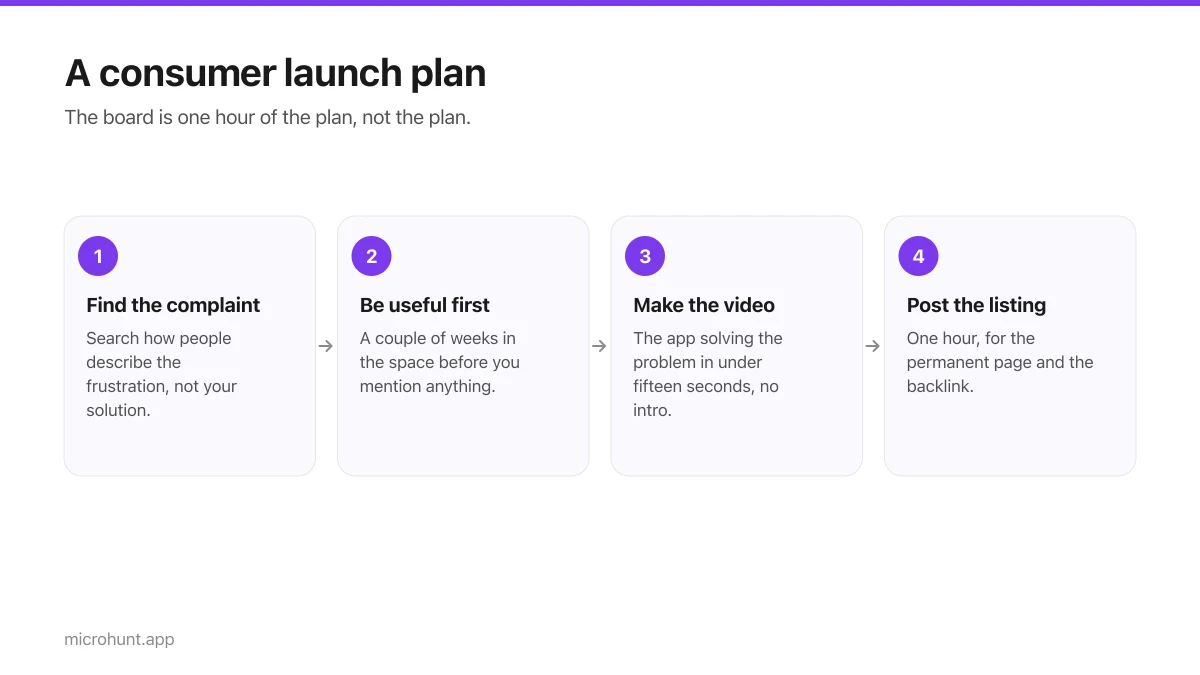
- 1Search for the complaint, not the solutionPeople describing the frustration your app fixes are your users. They are rarely using your vocabulary for it.
- 2Read for a couple of weeksLearn how they describe the problem. That language belongs in your app store description.
- 3Be useful without linkingAnswer questions in the space. Communities are ruthless with drive-by promotion and generous with genuine members.
- 4Then mention it onceWhen it genuinely answers someone's question. One well-placed comment beats fifty posts.
The store listing is your real landing page
Most consumer installs are decided on a store page, not a website. The first two screenshots and the first line of the description do nearly all the work, and the same rules apply as anywhere — show the app doing the thing, use the words your user uses, and answer the obvious objection about price and account requirements immediately.
The mechanics of the board day itself are the same as any launch — see the seven-day checklist — just with expectations set to visibility rather than installs.
Frequently asked questions
- Do consumer apps do well on launch boards?
- They get visibility and a permanent listing, but few retained users. Launch board audiences are mostly people who build software rather than people experiencing the problem a consumer app solves.
- Where do consumer apps find their first users?
- Niche communities where people already discuss the problem, and short video that shows the app working in seconds. Both reach people with the problem rather than people who enjoy new products.
- Should I skip launch boards for a consumer app?
- No — just calibrate. An hour spent on a good listing gives you an indexed page, a backlink and occasional press pickup that keeps working for years. Expect visibility, not installs.
- What matters most for consumer app conversion?
- The store listing, specifically the first two screenshots and the opening line. Most install decisions happen there rather than on your website.
Keep reading
Best Product Hunt Alternatives for Launching in 2026
Where else to launch when Product Hunt is not the right fit — what each platform is actually good at, who shows up, and what it costs.
Building an Audience Before You Launch (Without a Big Following)
You do not need thousands of followers. You need thirty people who know what you are building — here is how that actually happens.
Product Screenshots and Demo Videos That Do the Selling
Your first screenshot is your social preview and often the only thing a visitor looks at. Here is how to make it earn that.