Using Launch Deals Without Wrecking Your Pricing
7 min read
The short answer
A launch deal works best when it is time-boxed, small enough not to reset your price anchor, and aimed at people who would have bought anyway. Deep lifetime discounts attract bargain hunters who churn and never refer, and they make full price feel like a mistake to everyone who sees both. Prefer extra value over a lower number.
A deal badge makes a listing stand out in a feed, which is a real advantage. It also sets an expectation about what your product costs, and that expectation is hard to move afterwards. Both things are true at once, so the design of the offer matters more than whether to have one.
What different offers actually attract
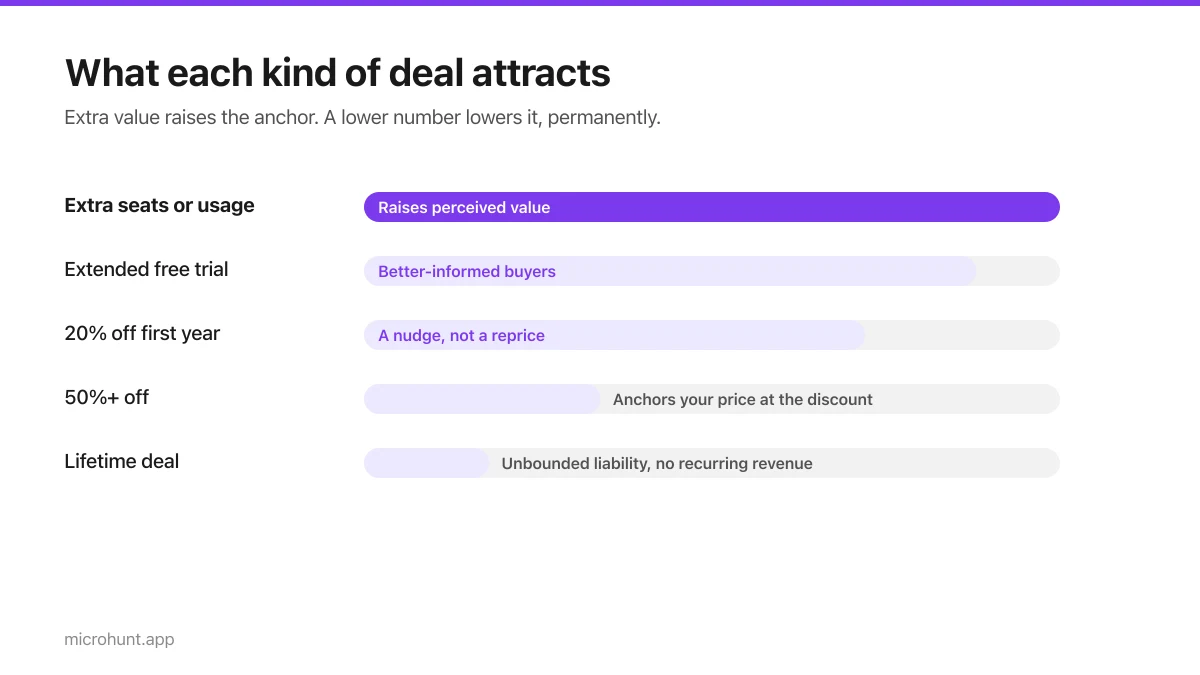
| Offer | Attracts | Long-term effect |
|---|---|---|
| 20% off first year | People who were already interested | Minimal — a nudge, not a reprice |
| Extended free trial | People who want to evaluate properly | Positive — better-informed buyers |
| Extra usage or seats | Teams sizing you up | Positive — raises perceived value |
| 50%+ off | Price-sensitive buyers | Anchors your price at the discount |
| Lifetime deal | Bargain hunters and resellers | Permanent support cost, no recurring revenue |
The anchoring problem
The first price someone sees becomes their sense of what the thing is worth. Launch at half price and the people who arrive during your launch — which is the largest single group you will ever get at once — learn that the real price is the discounted one.
The tell comes later: full-price signups feel slow, the temptation to run another sale appears, and after two or three the discount is simply your price. This is much easier to avoid than to reverse.
The lifetime deal question
Lifetime deals are genuinely tempting for an early product. A lump of cash and a group of users arrive at once, which solves two real problems on the same afternoon.
The cost is that you have sold an unbounded liability for a fixed price. Every one of those users can file support tickets and consume infrastructure indefinitely, and none will ever pay again. Lifetime buyers also skew towards collecting deals rather than using products, so the usage is uneven and the referrals rarely materialise.
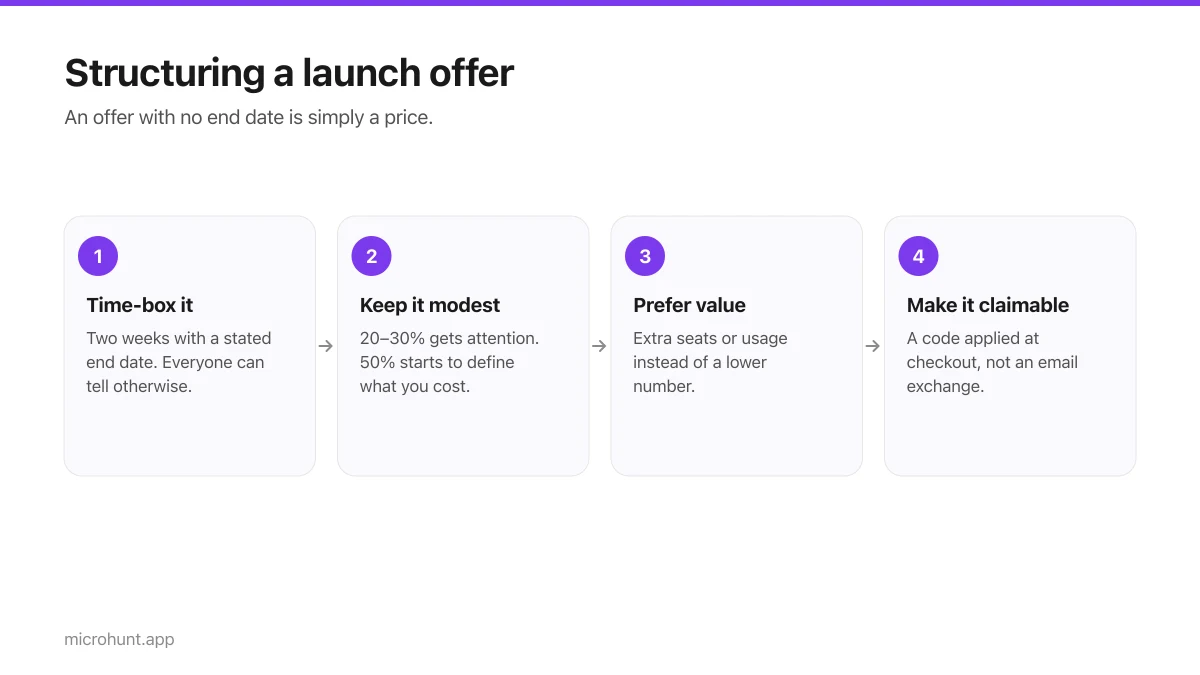
How to structure a launch offer
- 1Time-box itTwo weeks, with a stated end date. An offer with no end is a price, and everyone can tell.
- 2Keep it modestTwenty to thirty percent gets attention without resetting the anchor. Fifty starts to define you.
- 3Prefer value over priceExtra seats, a longer trial, or a higher usage tier all raise perceived value instead of lowering it.
- 4Make it easy to claimA code on the page, applied at checkout. Anything requiring an email exchange loses most of the people it attracted.
On the listing
A deal earns a badge on your row and a place on the deals page, which is one of the few free ways to stand out in a feed. Write the offer as a specific claim — "40% off the first year" — rather than "special launch pricing", which tells a reader nothing and gets skipped.
One last thing worth saying plainly: a deal will not rescue a product people do not want. If your launch is quiet, discounting will produce a quiet launch at a lower price. The problem is upstream, usually in the tagline.
Frequently asked questions
- Should I offer a discount when I launch?
- A modest, time-boxed one works well — around 20–30% for a stated period. It draws attention without teaching your market that the discounted price is the real one.
- Are lifetime deals a good idea?
- They solve cash and users on the same day and create an unbounded support liability with no recurring revenue. If you run one, cap the number, cap the included usage, and state what happens if the product shuts down.
- How big should a launch discount be?
- Twenty to thirty percent is enough to be noticed. Past fifty you start attracting price-sensitive buyers who churn, and you anchor everyone's sense of your price at the discount.
- Is extra value better than a discount?
- Usually. More seats, a longer trial or higher usage limits raise what the product appears to be worth, while a lower number lowers it — and the number is much harder to move back up.
Keep reading
Free vs Paid Launch Platforms: What the Money Actually Buys
Paid placement, featured slots and submission services — what each one gets you, and the two cases where spending is genuinely worth it.
How to Submit a Product on Vuru (Step by Step)
A walk through the submission form, what each field does to your page, and the fields most people leave empty that they shouldn't.
What to Do the Week After Launch Day
The traffic spike is over. Here is how to turn a day of attention into something that lasts longer than the graph.